Today's
EarthStation1.com 15% Off Commemorative Memorial Title: The
Holiday Treasure (The Thanksgiving Treasure) Jason Robards MP4 DVD
Today, November 29, 2025
( #JCKaelin here: My wife and I celebrate
Friendsgiving on the Saturday or Sunday after Thanksgiving with
our own chosen family :) ) ========= Friendsgiving (No Set Day):
-- Friendsgiving is a Thanksgiving-themed feast meal typically
eaten prior to, after, or instead of a family Thanksgiving dinner
in the United States. Those gathering are typically a group of
close friends, often Generation X, Generation Y (Millennials) and
Generation Z, although participation has broadened to Baby
Boomers. The meal began as an alternative to the traditional
family Thanksgiving gathering for people who could not or did not
want to go home for the holiday. It has since developed into an
additional celebration on a separate day during the Thanksgiving
season. The meal itself is often produced potluck-style, with each
participant bringing items. Those celebrated on Thanksgiving Day
generally replicate a Thanksgiving dinner, while those that are
additional gatherings may or may not, depending on the situation.
Early Friendsgiving meals were generally gatherings of close
friends who live in the same area as an alternative to a family
Thanksgiving. When celebrated on Thanksgiving Day, the meal is
most common in cities with many transplants, for whom traveling
home for the traditional meal is logistically or emotionally
difficult. Since then, Friendsgiving has generally come to mean a
Thanksgiving dinner celebrated with friends. There is as yet no
set date for Friendsgiving to occur; different sources cite the
Wednesday before or the Friday after Thanksgiving Day. It is this
very flexibility in the date of the holiday that is largely
responsible for its growing popularity. Its growth in popularity
is also attributed to several social elements, including the
chosen family - a family of choice, also known as a found family,
kith and kin, or hanai family - a term that refers to a
non-biologically related group of people established to provide
ongoing social support. The very coining of the portmanteau
compound word of "thanks" and "giving" are
also cited as responsible for its growing popularity, as well as
the evolution of Thanksgiving in the United States from a
single-day event into a Thanksgiving season. The meal is also
often celebrated among groups of coworkers as a potluck holiday
party. While the concept isn't new, prior to the early 2000s there
was no term for it. According to Merriam-Webster, the earliest use
of the term Friendsgiving dates back to a 2007 tweet that referred
to an informal meal in celebration of the Thanksgiving holiday. A
2011 ad campaign by Baileys Irish Cream liqueur with a
Friendsgiving theme used the word, giving the Friendsgiving
movement more momentum. The concept was a plot point on an episode
of the popular reality television show "Friends",
inspiring the concept of spending the holiday with friends. The
evolution of the concept into an additional (rather than
alternative) meal came later, according to Merriam-Webster. By
2013, the Emily Post Institute started receiving etiquette
questions about the meal. According to The Atlantic magazine, the
term wasn't frequently searched on Google prior to 2012, but by
2013 was being searched regularly and from then, searches on the
term increased exponentially in following years. On Sale @ 15% Off
Discount Till Midnight PT!
https://store.earthstation1.com/the-holiday-treasure-the-thanksgiving-treasure-jason-robards-mp4-dvd.html
Today's
EarthStation1.com 15% Off Commemorative Memorial Title: New York
City History Documentary Collection MP4 Video Download DVD
Today, November 29, 2025
November 29-30, 2024: New York City (New
York, NYC): The History Of New York City: Manhattan:
Manhattanhenges: Sunrise Manhattanhenge Day: -- Sunrise
Manhattanhenge occurs, when the rising Sun's disk is visible above
the horizon as it lines up with the east-west streets of the main
street grid of Manhattan, New York City. Excellent places for
viewing Manhattanhenge are 14th, 23rd, 34th, 42nd, and 57th
Streets. Manhattanhenge, also jocularly called the Manhattan
Solstice, an event during which the setting sun or the rising sun
is aligned with the east-west streets of the main street grid of
Manhattan, New York City. The sunsets and sunrises each align
twice a year, on dates evenly spaced around the summer solstice
and winter solstice. The Summer Solstice 2022 Manhattanhenge dates
are as follows: On May 29, 2022, Half-Sun Manhattanhenge occurs,
when the upper half of the setting Sun's disk is visible above the
horizon; On May 30, 2022, Full-Sun Manhattanhenge occurs, when the
full setting Sun's disk is visible above the horizon; On July 11,
2022, Full-Sun Manhattanhenge occurs, when the full setting Sun's
disk is visible above the horizon; On July 12, 2022, Half-Sun
Manhattanhenge occurs, when the upper half of the setting Sun's
disk is visible above the horizon. On November 29 -30, 2022,
Sunrise Manhattanhenge occurs, when the rising Sund's disk is
visible above the horizon; Sunrise Manhattanhenge repeats on
January 11-12, 2023. The term Manhattanhenge was coined in 1997 by
astrophysicist and native New Yorker Neil deGrasse Tyson of The
American Museum of Natural History in their magazine "Natural
History". It is a reference to Stonehenge, the prehistoric
monument located in Wiltshire, England, which was constructed so
that the rising sun, seen from the center of the monument at the
time of the summer solstice, aligned with the outer "Heel
Stone" of the monument. The precise dates of Manhattanhenge
depend on the date of the summer solstice, which varies from year
to year, but remains close to June 21. On Sale @ 15% Off Discount
Till Midnight PT!
https://store.earthstation1.com/new-york-city-history-videos-3-dvd-se3.html
Today's
EarthStation1.com 15% Off Commemorative Memorial Title: The Genius
That Was China Documentary Series DVD, Download, USB Drive
Today, November 29, 2025
November 29, 1835: #BOTD: Empress Dowager
Cixi (pronouced "TSOO-Shee"; formerly romanised as
Empress Dowager T'zu-Hsi) of China, Chinese empress dowager (the
title given to the mother or widow of a Chinese, Japanese, Korean
or Vietnamese emperor) and regent of the Manchu Yehenara clan who
effectively controlled the Chinese government in the late Qing
dynasty for 47 years from 1861 until her death (d. November 15,
1908) is #born Yehe Nara Xingzhen in Beijing, Qing Empire, China.
Selected as an imperial concubine of the Xianfeng Emperor in her
adolescence, she gave birth to a son, Zaichun, in 1856. After the
Xianfeng Emperor' death in 1861, the young boy became the Tongzhi
Emperor, and she became the Empress Dowager. Cixi ousted a group
of regents appointed by the late emperor and assumed regency,
which she shared with Empress Dowager Ci'an. Cixi then
consolidated control over the dynasty when she installed her
nephew as the Guangxu Emperor at the death of the Tongzhi Emperor
in 1875, contrary to the traditional rules of succession of the
Qing dynasty that had ruled China since 1644. Although she refused
to adopt Western models of government, she supported technological
and military reforms, such as creation of the New Army that was
the modernized army corps formed under the Qing dynasty in
December 1895, and the Self-Strengthening Movement, a period of
institutional reforms initiated in China during the late Qing
dynasty following a series of military defeats and concessions to
foreign powers. Although she agreed with the principles of the
Hundred Days' Reforms, a failed 103-day national, cultural,
political, and educational reform movement from 11 June to 21
September 1898 undertaken by the young Guangxu Emperor and his
reform-minded supporters, it ended in a coup d'etat ("The
Coup Of 1898", Wuxu Coup) by powerful conservative opponents
led by Empress Dowager Cixi. Cixi rejected their sudden
implementation, without bureaucratic support, as detrimental to
dynastic power. She placed the Guangxu Emperor, who had tried to
assassinate her, under virtual house arrest for supporting radical
reformers. She may have feared that any perceived weakness in the
Imperial Court would have been pounced upon by the Japanese. After
the Boxer Rebellion (a violent anti-foreign, anti-colonial, and
anti-Christian uprising that took place in China between 1899 and
1901) led to the retaliatory invasion of the Eight-Nation Alliance
(Japan, Russia, Britain, France, the United States, Germany, Italy
and Austro-Hungary), Cixi supported the Boxer groups for
supporting the dynasty and attacking the foreigners. The ensuing
Allied defeat of the Chinese forces was a stunning humiliation.
When Cixi returned to Beijing from Xi'an, where she had taken the
emperor, she became friendly to foreigners in the capital and
began to implement fiscal and institutional reforms known as the
New Policies, a series of cultural, economic, educational,
military, and political reforms that were implemented in the last
decade of the Qing dynasty to keep the dynasty in power after the
humiliating defeat in the Boxer Rebellion, which began to turn
China into a constitutional monarchy. The death of both Cixi and
the Guangxu Emperor in 1908 left the court in the hands of Manchu
conservatives, a child on the throne, and a restless, rebellious
public. Historians both in China and abroad have long portrayed
her as a despot responsible for the fall of the Qing dynasty.
Others have suggested that her opponents among the reformers and
revolutionaries succeeded in blaming her for problems beyond her
control. Furthermore, they say that she intervened decisively to
prevent political disorder, was no more ruthless than other rulers
of her time, and that she was an effective reformer in the last
years of her life, even if she was reluctant to take on this role.
Empress Dowager Cixi died in the Hall of Graceful Bird at the
Middle Sea of Zhongnanhai, Beijing, after having installed Puyi as
the new emperor the day prior on November 14, 1908. Her death came
only a day after the death of the Guangxu Emperor, who was her
nephew, and over whom Cixi wielded actual rulership over China
from 1875 till 1889. She was buried at The Eastern Qing Tombs, an
imperial mausoleum complex of the Qing dynasty located in Zunhua,
125 kilometres (78 mi) northeast of Beijing. On November 4, 2008,
forensic tests concluded that her nephew the Guangxu Emperor died
from acute arsenic poisoning; China Daily quoted the historian Dai
Yi in speculating that Cixi may have known of her imminent death,
and may have poisoned the Guangxu Emperor and installed Puyi as
the new emperor of China out of worry that the Guangxu Emperor
would continue his military, political and social reforms after
her death. It was reported in November 2008 that the level of
arsenic in the Guangxu Emperor's remains was 2,000 times higher
than that of ordinary people. On Sale @ 15% Off Discount Till
Midnight PT!
https://store.earthstation1.com/the-genius-that-was-china-dvd-tv-documentary-series-2-disc-se2.html
Today's
EarthStation1.com 15% Off Commemorative Memorial Title: Thomas A.
Edison: The Wizard Of Menlo Park + 3 Bonus Titles MP4 DVD
Today, November 29, 2025
November 29, 1877: Great Inventions: The
History Of Sound Recording: The Phonograph: -- Thomas Edison
demonstrates his phonograph, a machine that can record and play
sound, for the first time. On November 21, Edison first announced
his invention to the public. Alexander Graham Bell's Volta
Laboratory made several improvements in the 1880s and introduced
the graphophone, including the use of wax-coated cardboard
cylinders and a cutting stylus that moved from side to side in a
zigzag groove around the record. In the 1890s, Emile Berliner
initiated the transition from phonograph cylinders to flat discs
with a spiral groove running from the periphery to near the
center, coining the term gramophone for disc record players, which
is predominantly used in many languages. Later improvements
through the years included modifications to the turntable and its
drive system, the stylus or needle, and the sound and equalization
systems. Whether called a phonograph, in its later forms a
gramophone (as a trademark since 1887, as a generic name in the UK
since 1910) or since the 1940s called a record player, it is a
device for the mechanical recording and reproduction of sound. The
sound vibration waveforms are recorded as corresponding physical
deviations of a spiral groove engraved, etched, incised, or
impressed into the surface of a rotating cylinder or disc, called
a "record". To recreate the sound, the surface is
similarly rotated while a playback stylus traces the groove and is
therefore vibrated by it, very faintly reproducing the recorded
sound. In early acoustic phonographs, the stylus vibrated a
diaphragm which produced sound waves which were coupled to the
open air through a flaring horn, or directly to the listener's
ears through stethoscope-type earphones. The disc phonograph
record was the dominant audio recording format throughout most of
the 20th century. In the 1980s, phonograph use on a standard
record player declined sharply due to the rise of the cassette
tape, compact disc, and other digital recording formats. However,
records are still a favorite format for some audiophiles, DJs and
turntablists (particularly in hip hop and electronic dance music),
and have undergone a revival since the 1990s. The original
recordings of musicians, which may have been recorded on tape or
digital methods, are sometimes re-issued on vinyl. On Sale @ 15%
Off Discount Till Midnight PT!
https://store.earthstation1.com/thomas-a-edison-the-wizard-of-menlo-park-dvd.html
Today's
EarthStation1.com 15% Off Commemorative Memorial Title: Axis Sally
aka Mildred Gillars Nazi Radio Set MP3 CD, Download, USB
Today, November 29, 2025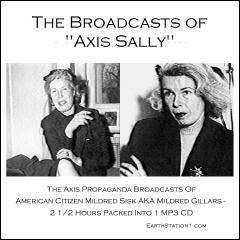
November 29, 1900: #BOTD: Mildred
Gillars, nicknamed Axis Sally by Allied forces, American radio
broadcaster employed by Nazi Germany to produce, voice and
broadcast despicable radio propaganda during WWII (d. June 25,
1988) is #born Mildred Elizabeth Sisk in Portland, Maine, she took
the surname Gillars in 1911 after her mother remarried. Mildred
Gillars, along with Rita Zucca, were nicknamed "Axis Sally",
a name used to describe any single female voice directing her
comments by way of German radio to Allied soldiers during World
War II. Mildred Gillars was the highest paid radio personality in
Nazi Germany, and worked at Reichs-Rundfunk-Gesellschaft (RRG),
German State Radio. After the defeat of Nazi Germany Gillars was
convicted of treason by the United States in 1949 following her
capture in post-war Berlin. Having converted to Roman Catholicism
while in prison, Gillars went to live at the Our Lady of Bethlehem
Convent in Columbus, Ohio, and taught German, French, and music at
St. Joseph Academy, Columbus. Mildred Gillars died of colon cancer
at Grant Medical Center in Columbus, aged 87. She is buried at
Saint Joseph Cemetery in Lockbourne, Franklin County, Ohio. On
Sale @ 15% Off Discount Till Midnight PT!
https://store.earthstation1.com/axis-sally-mp3-cd-mildred-gillars-wwii-german-radio-broadcast3.html
Today's
EarthStation1.com 15% Off Commemorative Memorial Title: A Duke
Named Ellington TV Series Duke Ellington DVD Download USB Drive
Today, November 29, 2025
November 29, 1915: #BOTD: #HBD! Billy
Strayhorn, African American jazz composer, pianist, lyricist, and
arranger, best known for his successful collaboration with
bandleader and composer Duke Ellington, lasting nearly three
decades (d. May 31, 1967) is #born William Thomas Strayhorn in
Dayton, Ohio. Billy Strayhorn's compositions include "Take
the 'A' Train", "Lush Life", "Chelsea Bridge"
and "A Flower Is a Lovesome Thing". His family moved to
the Homewood section of Pittsburgh, Pennsylvania soon after he was
born. However, his mother's family was from Hillsborough, North
Carolina, and she sent him there to protect him from his father's
drunken sprees. Strayhorn spent many months of his childhood at
his grandparents' house in Hillsborough. In an interview,
Strayhorn said that his grandmother was his primary influence
during the first ten years of his life. He first became interested
in music while living with her, playing hymns on her piano, and
playing records on her Victrola record player. Strayhorn returned
to Pittsburgh, and attended Westinghouse High School, later
attended by Erroll Garner and Ahmad Jamal. In Pittsburgh, he began
his musical career, studying classical music for a time at the
Pittsburgh Music Institute, writing a high school musical, forming
a musical trio that played daily on a local radio station, and,
while still in his teens, composing (with lyrics) the songs "Life
Is Lonely" (later renamed "Lush Life"), "My
Little Brown Book", and "Something to Live For".
While still in grade school, he worked odd jobs to earn enough
money to buy his first piano, and took lessons from Charlotte Enty
Catlin. While in high school, he played in the school band, and
studied under Carl McVicker, who had also instructed jazz pianists
Erroll Garner and Mary Lou Williams. By age 19, he was writing for
a professional musical, Fantastic Rhythm. Though classical music
was Strayhorn's first love, his ambition to become a classical
composer was shot down by the harsh reality of a black man trying
to make it in the classical world, which at that time was almost
completely white. Strayhorn was then introduced to the music of
pianists like Art Tatum and Teddy Wilson at age 19. The artistic
influence of these musicians guided him into the realm of jazz
where he remained for the rest of his life. His first jazz
exposure was in a combo called the Mad Hatters that played around
Pittsburgh. Strayhorn's fellow students, guitarist Bill Esch and
drummer Mickey Scrima, also influenced his move towards jazz, and
he began writing arrangements for Buddy Malone's Pittsburgh dance
band after 1937. He met Duke Ellington in December 1938, after an
Ellington performance in Pittsburgh (he had first seen Ellington
play in Pittsburgh in 1933). Here he first told, and then showed
the band leader how he would have arranged one of Duke's own
pieces. Ellington was impressed enough to invite other band
members to hear Strayhorn. At the end of the visit, he arranged
for Strayhorn to meet him when the band returned to New York.
Strayhorn worked for Ellington for the next quarter century as an
arranger, composer, occasional pianist and collaborator until his
early death from cancer. As Ellington described him, "Billy
Strayhorn was my right arm, my left arm, all the eyes in the back
of my head, my brain waves in his head, and his in mine."
Strayhorn's relationship with Ellington was always difficult to
pin down: Strayhorn was a gifted composer and arranger who seemed
to flourish in Duke's shadow. Ellington was arguably a father
figure and the band was affectionately protective of the
diminutive, mild-mannered, unselfish Strayhorn, nicknamed by the
band "Strays", "Weely", and "Swee' Pea".
Ellington may have taken advantage of him, but not in the
mercenary way in which others had taken advantage of Ellington;
instead, he used Strayhorn to complete his thoughts and introduce
new musical ideas, while giving him the freedom to write on his
own and enjoy at least some of the credit he deserved. Though Duke
Ellington took credit for much of Strayhorn's work, he did not
maliciously drown out his partner. Ellington would make jokes
onstage like, "Strayhorn does a lot of the work but I get to
take the bows!" On the other hand, Ellington did not oppose
his publicists' frequently crediting him without any mention of
Strayhorn, and, despite the latter's attempts to hide his
dissatisfaction, "Strayhorn revealed", at least to his
friends, "a deepening well of unease about his lack of public
recognition as Ellington's prominence grew." Strayhorn
composed the band's best known theme, "Take the 'A' Train",
and a number of other pieces that became part of the band's
repertoire. In some cases Strayhorn received attribution for his
work such as "Lotus Blossom", "Chelsea Bridge",
and "Rain Check", while others, such as "Day Dream"
and "Something to Live For", were listed as
collaborations with Ellington or, in the case of "Satin Doll"
and "Sugar Hill Penthouse", were credited to Ellington
alone. Strayhorn also arranged many of Ellington's
band-within-band recordings and provided harmonic clarity, taste,
and polish to Duke's compositions. On the other hand, Ellington
gave Strayhorn full credit as his collaborator on later, larger
works such as Such Sweet Thunder, A Drum Is a Woman, The Perfume
Suite and The Far East Suite, where Strayhorn and Ellington worked
closely together. Strayhorn also often sat in on the piano with
the Ellington Orchestra, both live and in the studio. Detroit Free
Press music critic Mark Stryker concludes that the work of
Strayhorn and Ellington in the score of the 1959 Hollywood film
Anatomy of a Murder, Otto Preminger's 1959 American courtroom
drama crime film, is "indispensable, [although] ... too
sketchy to rank in the top echelon among Ellington-Strayhorn
masterpiece suites like Such Sweet Thunder and The Far East Suite,
but its most inspired moments are their equal." Film
historians have recognized the soundtrack "as a landmark-the
first significant Hollywood film music by African Americans
comprising non-diegetic music, that is, music whose source is not
visible or implied by action in the film, like an on-screen band."
The score "avoided the cultural stereotypes that previously
characterized jazz scores and rejected a strict adherence to
visuals in ways that presaged the New Wave cinema of the '60s."
In 1960 the two collaborated on the album The Nutcracker Suite,
recorded for the Columbia label and featuring jazz interpretations
of "The Nutcracker" by Tchaikovsky, arranged by the two.
The original album cover is notable for the inclusion of
Strayhorn's name and picture along with Ellington's on the front.
Shortly before going on his second European tour with his
orchestra, from March to May 1939, Ellington announced to his
sister Ruth and son Mercer Ellington that Strayhorn "is
staying with us." Through Mercer, Strayhorn met his first
partner, African American musician Aaron Bridgers, with whom
Strayhorn lived until Bridgers moved to Paris in 1947. Strayhorn
was openly gay. He participated in many civil rights causes. As a
committed friend to Martin Luther King Jr., he arranged and
conducted "King Fit the Battle of Alabama'" for the
Ellington Orchestra in 1963 for the historical revue (and album)
My People, dedicated to King. Strayhorn's strong character left an
impression on many people who met him. He had a major influence on
the career of Lena Horne, who wanted to marry Strayhorn and
considered him to have been the love of her life. Strayhorn used
his classical background to improve Horne's singing technique.
They eventually recorded songs together. In the 1950s, Strayhorn
left his musical partner Duke Ellington for a few years to pursue
a solo career of his own. He released a few solo albums and revues
for the Copasetics (a New York show-business society), and took on
theater productions with his friend Luther Henderson. In 1964,
Strayhorn was diagnosed with esophageal cancer, the disease that
took his life in 1967. Strayhorn finally succumbed in the early
morning on May 31, 1967, in the company of his partner, Bill
Grove, not in Lena Horne's arms as has often been falsely
reported. By her own account, she was touring in Europe when she
received the news of Strayhorn's death. His ashes were scattered
in the Hudson River by a gathering of his closest friends. While
in the hospital, he had submitted his final composition to
Ellington. "Blood Count" was used as the third track to
Ellington's memorial album for Strayhorn, _And His Mother Called
Him Bill, which was recorded several months after Strayhorn's
death. The last track of the album is a spontaneous solo version
of "Lotus Blossom" performed by Ellington, who sat at
the piano and played for his friend while the band (who can be
heard in the background) were packing up after the formal end of
the recording session. Strayhorn's arrangements had a tremendous
impact on the Ellington band. Ellington always wrote for the
personnel he had at the time, showcasing both the personalities
and sound of soloists such as Johnny Hodges, Harry Carney, Ben
Webster, Lawrence Brown and Jimmy Blanton, and drawing on the
contrasts between players or sections to create a new sound for
his band. Strayhorn brought a more linear, classically schooled
ear to Ellington's works, setting down in permanent form the sound
and structures that Ellington sought. A Pennsylvania State
Historical Marker highlighting Strayhorn's accomplishments was
placed at Westinghouse High School in Pittsburgh, from which he
graduated. In North Carolina, a state historical marker honoring
Strayhorn is located in downtown Hillsborough, near his "boyhood
home". The former Regent Theatre in Pittsburgh's East Liberty
neighborhood was renamed the Kelly Strayhorn Theater in honor of
Strayhorn and fellow Pittsburgher Gene Kelly in 2000. It is a
community-based performing arts theater. In 2015 Strayhorn was
inducted into the Legacy Walk. In his autobiography and in a
spoken word passage in his Second Sacred Concert, Duke Ellington
listed what he considered Strayhorn's "four major moral
freedoms": "freedom from hate, unconditionally; freedom
from self-pity (even through all the pain and bad news); freedom
from fear of possibly doing something that might possibly help
another more than it might himself and freedom from the kind of
pride that might make a man think that he was better than his
brother or his neighbor."
https://store.earthstation1.com/a-duke-named-ellington-dvd-complete-2-part-tv-serie2.html
Today's
EarthStation1.com 15% Off Commemorative Memorial Title: Aviation
History Films Collection DVD MP4 Video Download
Today, November 29, 2025
November 29, 1929: Polar Exploration:
South Pole Exploration: Aviation: The History Of Aviation: The
History Of Polar Flight: Richard E. Byrd's 1929 South Pole Flight:
-- The first airplane flight to the South Pole is completed when
U.S. Admiral Richard E. Byrd, flying in his 1928 Ford 4-AT-B
Tri-Motor Airplane named "Floyd Bennett" (named for the
recently deceased pilot of Byrd's previous expeditions including
his flight over the North Pole in 1926), along with his Norwegian
pilot Bernt Balchen, co-pilot/radioman Harold June and
photographer Ashley McKinley, fly from their "Little America"
exploration base on Antarctica's Ross Ice Shelf to the South Pole
and back in 18 hours, 41 minutes. They had difficulty gaining
enough altitude, and they had to dump empty gas tanks, as well as
their emergency supplies, in order to achieve the altitude of the
Polar Plateau, but they were ultimately successful. His Navy Cross
citation reads: "The President of the United States of
America takes pleasure in presenting the Navy Cross to Rear
Admiral Richard Evelyn Byrd Jr. (NSN: 0-7918), United States Navy,
for extraordinary heroism in the line of his profession as
Commanding Officer of the Byrd Antarctic Expedition I, in that on
November 28, 1929 he took off in his "Floyd Bennett"
from the Expedition's base at Little America, Antarctica and,
after a flight made under the most difficult conditions he reached
the South Pole on November 29, 1929. After flying some distance
beyond this point he returned to his base at Little America. This
hazardous flight was made under extreme conditions of cold, over
ranges and plateaus extending nine to ten thousand feet above sea
level and beyond probable rescue of personnel had a forced landing
occurred. Rear Admiral Richard E. Byrd, U.S.N, Retired, was in
command of this flight, navigated the airplane, made the mandatory
preparations for the flight, and through his untiring energy,
superior leadership, and excellent judgment the flight was brought
to a successful conclusion.". On Sale @ 15% Off Discount Till
Midnight PT!
https://store.earthstation1.com/aviation-history-films-2-dual-layer-dvd-se2.html
Today's
EarthStation1.com 15% Off Commemorative Memorial Title: Rock &
Roll An Unruly History 10 Part TV Series MP4 Video Download DVD
Today, November 29, 2025
November 29, 1933: #BOTD: #HBD! John
Mayall, nicknamed "The Godfather Of The British Blues",
English blues and rock singer, guitarist, harmonica player,
songwriter, keyboardist and record producer, founder of the John
Mayall & The Bluesbreakers that has counted among its members
some of the most famous blues and blues rock musicians. A , he had
a career that spanned nearly seven decades, remaining an active
musician until his death (d. July 22, 2024) is #born John Brumwell
Mayall in Macclesfield, Cheshire, North West England. John
Brumwell Mayall OBE died at an undisclosed location in California,
aged 90. His remains were cremated; the final disposition of his
ashes are not publicly disclosed. He was inducted into the Rock
and Roll Hall of Fame in the musical influence category in 2024.
On Sale @ 15% Off Discount Till Midnight PT!
https://store.earthstation1.com/rock-amp-roll-an-unruly-history-10-part-tv-series-mp4-video-download-104.html
Today's
EarthStation1.com 15% Off Commemorative Memorial Title: Rod
Serling: The Twice-Promised Land + The Birth Of Israel MP4 Or DVD
Today, November 29, 2025
November 29, 1947: The Aftermath Of World
War II: The Cold War: The Decolonization Of Asia: The Arab-Israeli
Conflict: Mandatory Palestine: Intercommunal Conflict In Mandatory
Palestine: The Israeli-Palestinian Conflict: The United Nations
Partition Plan for Palestine (United Nations Resolution 181 (II)):
-- The United Nations proposal to partition of Mandatory Palestine
at the end of the British Mandate is adopted by the United Nations
General Assembly as UN General Assembly Resolution 181, which
creates independent Arab and Jewish States and a Special
International Regime for the city of Jerusalem, and ultimately
results in the establishment of the Jewish state of Israel the
following year. The partition plan was accepted by Jewish Agency
for Palestine and by most Zionist factions, despite its perceived
limitations; only the fringes expressed dissatisfaction over
territorial limits set on the proposed Jewish State. The Arab
Higher Committee, the Arab League and other Arab leaders and
governments rejected it and indicated an unwillingness to accept
any form of territorial division, arguing that it violated the
principles of national self-determination in the UN Charter which
granted people the right to decide their own destiny. They
announced their intention to take all necessary measures to
prevent the implementation of the resolution, and immediately
afterwards the 1947-48 Civil War in Mandatory Palestine broke out,
the beginning of the 1948 Palestine War, and the plan was not
implemented. The Partition Plan, a four-part document attached to
the resolution, provided for the termination of the Mandate, the
progressive withdrawal of British armed forces and the delineation
of boundaries between the two States and Jerusalem. Part I of the
Plan stipulated that the Mandate would be terminated as soon as
possible and the United Kingdom would withdraw no later than 1
August 1948. The new states would come into existence two months
after the withdrawal, but no later than 1 October 1948. The Plan
sought to address the conflicting objectives and claims of two
competing movements, Palestinian nationalism and Jewish
nationalism, or Zionism. The Plan also called for Economic Union
between the proposed states, and for the protection of religious
and minority rights. While Jewish organizations collaborated with
UNSCOP during the deliberations, the Arab Palestinian leadership
opted not to participate. On Sale @ 15% Off Discount Till Midnight
PT!
https://store.earthstation1.com/perspective-on-greatness-the-twicepromised-land-dvd-israel.html
Today's
EarthStation1.com 15% Off Commemorative Memorial Title: Korean War
Films And Documentaries Collection DVD, MP4 Download, USB
Today, November 29, 2025
November 29, 1950: Korea: The History Of
Korea: The Aftermath Of World War II: The Cold War: The Cold War
In Asia: The Korean Conflict: The Cold War (1947-1953): The Cold
War In Asia: The Korean War: The Chinese Second Phase Campaign
(The Chinese Second Phase Offensive): The Battle Of The
Ch'ongch'on River, The Battle Of Chosin Reservoir: -- Following
their overwhelming success at the Battle Of Chosin Reservoir,
North Korean and Chinese troops force United Nations forces into
full retreat from North Korea. The Battle Of Chosin Reservoir
began the day prior, on November 29, 1950 as the 9th Army of the
Chinese People's Volunteer Army (PVA) surprised the US X Corps
commanded by Major General Edward Almond at the Chosin Reservoir
area. A brutal 17-day battle in freezing weather soon followed.
Between November 27 and December 13, 30,000 United Nations Command
troops (later nicknamed "The Chosin Few") under the
field command of Major General Oliver P. Smith were encircled and
attacked by about 120,000 Chinese troops under the command of Song
Shilun, who had been ordered by Mao Zedong to destroy the UN
forces. The UN forces were nevertheless able to break out of the
encirclement and to make a fighting withdrawal to the port of
Hungnam, inflicting heavy casualties on the Chinese. US Marine
units were supported in their withdrawal by the US Army's Task
Force Faith to their east, which suffered heavy casualties and the
full brunt of the Chinese offensive. The retreat of the US Eighth
Army from northwest Korea in the aftermath of the Battle Of The
Ch'ongch'on River and the evacuation of the X Corps from the port
of Hungnam in northeast Korea marked the complete withdrawal of UN
troops from North Korea. On Sale @ 15% Off Discount Till Midnight
PT!
https://store.earthstation1.com/korean-war-films-and-documentaries-dvd.html
Today's
EarthStation1.com 15% Off Commemorative Memorial Title: The Eagle
And The Bear: The Korean War 2 Part Series MP4 Download DVD
Today, November 29, 2025
November 29, 1952: Korea: The History Of
Korea: The Aftermath Of World War II: The Cold War: The Cold War
In Asia: The Korean Conflict: The Cold War (1947-1953): The Cold
War In Asia: The Korean War: The 1952 United States Presidential
Election: President Eisenhower: "I Shall Go To Korea":
-- U.S. President-elect Dwight D. Eisenhower fulfills a campaign
promise by traveling to Korea to find out what can be done to end
the conflict. Just two weeks before the election, Eisenhower vowed
to go to Korea and end the war there. He promised to maintain a
strong commitment against Communism while avoiding the topic of
NATO; finally, he stressed a corruption-free, frugal
administration at home. During the 1952 United States Presidential
Campaign, Republican candidate Eisenhower was critical of the
Truman administration's foreign policy, particularly its inability
to bring an end to the conflict in Korea. President Truman
challenged Eisenhower on October 24 to come up with an alternate
policy. Eisenhower responded with the startling announcement that
if he were elected, he would personally go to Korea to get a
firsthand view of the situation. The promise boosted Eisenhower's
popularity, and he defeated Democratic candidate Adlai Stevenson
II in a landslide, with an electoral margin of 442 to 89, marking
the first Republican return to the White House in 20 years. He
also brought a Republican majority in the House, by eight votes,
and in the Senate, evenly divided with Vice President Nixon
providing Republicans the majority. Shortly after his election,
Eisenhower fulfilled his campaign pledge, though he was not very
specific about exactly what he hoped to accomplish. After a short
stay he returned to the United States, yet remained mum about his
plans concerning the Korean War. After taking office, however,
Eisenhower adopted a get-tough policy toward the communists in
Korea. He suggested that he would "unleash" the
Nationalist Chinese forces on Taiwan against communist China, and
he sent only slightly veiled messages that he would use any force
necessary (including the use of nuclear weapons) to bring the war
to an end unless peace negotiations began to move forward. The
Chinese, exhausted by more than two years of war, finally agreed
to terms and an armistice was signed on July 27, 1953. The United
States suffered over 50,000 casualties in this "forgotten
war," and spent nearly 70B USD. The most frustrating war in
U.S. history thusfar, America's first experience with a "limited
war", one in which the nation did not seek, nor obtained,
absolute victory over the enemy, did not bode well for the future;
America's involvement in the Vietnam War was just a little over a
decade away. On Sale @ 15% Off Discount Till Midnight PT!
https://store.earthstation1.com/the-eagle-and-the-bear-the-korean-war-dvd-both-tv-documentaries.html
Today's
EarthStation1.com 15% Off Commemorative Memorial Title: Reasonable
Doubt: JFK Assassination Single-Bullet Theory DVD, MP4, USB
Today, November 29, 2025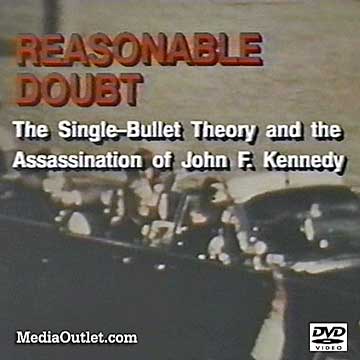
November 29, 1963: United States
Presidential Assassination Attempts And Plots: United States
Presidential Assassinations: The Assassination Of John F. Kennedy:
Executive Order 11130 (E.O. 11130): The President's Commission On
The Assassination Of President Kennedy (The Warren Commission): --
U.S. President Lyndon B. Johnson establishes the Warren Commission
to investigate the assassination of United States President John
F. Kennedy that had taken place on November 22, 1963. the
controversial Warren Commission Report was issued stating a lone
gunman had been responsible for the assassination of President
John F. Kennedy in Dallas on November 23, 1963. The U.S. Congress
passed Senate Joint Resolution 137 authorizing the Presidential
appointed Commission to report on the assassination of President
John F. Kennedy, mandating the attendance and testimony of
witnesses and the production of evidence. After a 10-month
investigation, its controversial 888-page final report was
presented to President Johnson on September 24, 1964, and made
public three days later. It concluded that President Kennedy was
assassinated by Lee Harvey Oswald and that Oswald acted entirely
alone.It also concluded that Jack Ruby acted alone when he killed
Oswald two days later. The Commission's findings have proven
controversial and have been both challenged and supported by later
studies. The Commission took its unofficial name, the Warren
Commission, from its chairman, Chief Justice Earl Warren.
According to published transcripts of Johnson's presidential phone
conversations, some major officials were opposed to forming such a
commission and several commission members took part only
reluctantly. One of their chief reservations was that a commission
would ultimately create more controversy than consensus. On Sale @
15% Off Discount Till Midnight PT!
https://store.earthstation1.com/reasonable-doubt-the-singlebullet-theory-dvd.html
Today's
EarthStation1.com 15% Off Commemorative Memorial Title: TV Music &
Dance Shows #4 The Beatles DVD, Video Download, Flash Drive
Today, November 29, 2025
November 29, 1963: Aesthetics: The
Performing Arts: Music: Music History: The History Of Rock And
Roll (Rock & Roll, Rock-N-Roll, Rock 'N' Roll, Rock 'N Roll,
Rock N' Roll): British Rock And Roll (British Rock & Roll,
British Rock-N-Roll, British Rock 'N' Roll, British Rock 'N Roll,
British Rock N' Roll): The Swinging Sixties: Music Of The United
Kingdom: Rock And Roll (Rock & Roll, Rock-N-Roll, Rock 'N'
Roll, Rock 'N Roll, Rock N' Roll): Concerts: British Rock (Beat
Music, British Beat, Merseybeat): The Swinging Sixties: Music Of
The United Kingdom: Rock And Roll (Rock & Roll, Rock-N-Roll,
Rock 'N' Roll, Rock 'N Roll, Rock N' Roll): The British Invasion:
The Beatles: Record Releases: -- "I Want to Hold Your Hand",
recorded on October 17, 1963, is released by the Beatles in the
United Kingdom. "I Want to Hold Your Hand" is a song by
the English rock band the Beatles. Written by John Lennon and Paul
McCartney, it was the first Beatles record to be made using
four-track equipment. With advance orders exceeding one million
copies in the United Kingdom, "I Want to Hold Your Hand"
would have gone straight to the top of the British record charts
on its day of release had it not been blocked by the group's first
million-seller "She Loves You", their previous UK
single, which was having a resurgence of popularity following
intense media coverage of the group. Taking two weeks to dislodge
its predecessor, "I Want to Hold Your Hand" stayed at
number one for five weeks and remained in the UK top 50 for 21
weeks in total. It was also the group's first American number-one
hit, entering the Billboard Hot 100 chart on January 18, 1964 at
number 45 and starting the British Invasion of the American music
industry. By February 1 it topped the Hot 100, and stayed there
for seven weeks before being replaced by "She Loves You".
It remained on the Billboard chart for 15 weeks. "I Want to
Hold Your Hand" became the Beatles' best-selling single
worldwide, selling more than 12 million copies. In 2018, Billboard
magazine named it the 48th biggest hit of all time on the
Billboard Hot 100. In the UK, it was the second highest selling
single of the 1960s, behind "She Loves You". On Sale @
15% Off Discount Till Midnight PT!
https://store.earthstation1.com/classic-tv-music-amp-dance-shows-4-the-beatles-dv4.html
Today's
EarthStation1.com 15% Off Commemorative Memorial Title: LBJ 1991
TV Documentary Series Lyndon Johnson DVD Download USB Drive
Today, November 29, 2025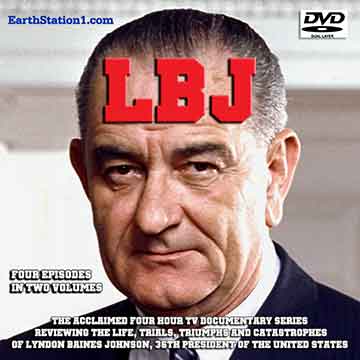
November 29, 1967:The Aftermath Of World
War II: The Cold War: The Cold War In Asia: The Indochina Wars:
The Vietnam War (The Second Indochina War, The Vietnam Conflict,
The Resistance War Against America): The United States In The
Vietnam War: Opposition To United States Involvement In The
Vietnam War: The Resignation Of U.S. Secretary Of Defense Robert
McNamara: -- Robert McNamara, having grown increasingly skeptical
of the efficacy of committing U.S. soldiers to Vietnam, announces
his resignation as Secretary Of Defense to become President of the
World Bank. In an early November 1967 memorandum to Johnson,
McNamara's recommendation to freeze troop levels, stop bombing
North Vietnam and for the U.S. to hand over ground fighting to
South Vietnam was rejected outright by the President. McNamara's
recommendations amounted to his saying that the strategy of the
United States in Vietnam which had been pursued to date had
failed. McNamara later stated he "never heard back" from
Johnson regarding the memo. Largely as a result, on November 29 of
that year, McNamara announced his pending resignation and that he
would become President of the World Bank. Other factors were the
increasing intensity of the anti-war movement in the U.S., the
approaching presidential campaign in which Johnson was expected to
seek re-election, and McNamara's support, over the objections of
the Joint Chiefs Of Staff, of construction along the 17th parallel
separating South and North Vietnam of a line of fortifications
running from the coast of Vietnam into Laos. The President's
announcement of McNamara's move to the World Bank stressed his
stated interest in the job and that he deserved a change after
seven years as Secretary Of Defense (longer than any of his
predecessors or successors). Others give a different view of
McNamara's departure from office. For example, Stanley Karnow in
his book Vietnam: A History strongly suggests that McNamara was
asked to leave by the President. The historian Arthur Schlesinger,
Jr. stated that he was present during a conversation between
McNamara and Senator Kennedy during which the former told the
latter that he only learned from reading the newspapers of
Johnson's announcement that he had just "resigned" as
Defense Secretary and had been appointed president of the World
Bank. McNamara himself expressed uncertainty about the question.
On November 17, 1967, a story in the Financial Times of London
based on leaked sources in Washington stated McNamara was going to
be the next World Bank president, which came as a considerable
surprise to McNamara. Afterwards, McNamara met with Kennedy who
told him to resign in protest and denounce the war as unwinnable,
counsel that McNamara rejected, saying that Johnson had been a
friend and that he was still loyal to him. When McNamara refused
to resign, Kennedy told him that he should turn down the World
Bank presidency and join him in criticizing the war, which
McNamara refused to do. Johnson knew that McNamara was concerned
about poverty in the Third World, and that the possibility of
serving as World Bank president would be too tempting for McNamara
to resist. McNamara left office on February 29, 1968; for his
efforts, the President awarded him both the Medal Of Freedom and
the Distinguished Service Medal. McNamara's last day as Defense
Secretary was a memorable one. The hawkish National Security
Adviser, Walt Whitman Rostow, argued at a cabinet meeting that day
that the United States was on the verge of winning the war. Rostow
urged Johnson to send 206,000 more American troops to South
Vietnam to join the half-million already there and to drastically
increase the number of bombing raids on North Vietnam. At that
point, McNamara snapped in fury at Rostow, saying: "What
then? This goddamned bombing campaign, it's worth nothing, it's
done nothing, they dropped more bombs than on all of Europe in all
of World War II and it hasn't done a fucking thing!" McNamara
then broke down in tears, saying to Johnson to just accept that
the war could not be won and stop listening to Rostow. Henry
McPherson, an aide to the president, recalled the scene: "He
reeled off the familiar statistics-how we had dropped more bombs
on Vietnam than on all of Europe during World War II. Then his
voice broke, and there were tears on his eyes as he spoke of the
futility, the crushing futility of the air war. The rest of us sat
silently - I for one with my mouth open, listening to the
Secretary Of Defense talk that way about a campaign for which he
had, ultimately, been responsible. I was pretty shocked".
Shortly after McNamara departed the Pentagon, he published The
Essence of Security, discussing various aspects of his tenure and
position on basic national security issues. He did not speak out
again on defense issues or Vietnam until after he left the World
Bank. On Sale @ 15% Off Discount Till Midnight PT!
https://store.earthstation1.com/lbj-1991-tv-documentary-series-lyndon-johnson-dvd-download-usb-d1991.html
Today's
EarthStation1.com 15% Off Commemorative Memorial Title:
Czechoslovakia: The Long Wait For Revolution DVD, Download, USB
Drive
Today, November 29, 2025
November 29, 1989: The Aftermath Of World
War II: The Cold War: The Cold War (1985-1991) (The End Of The
Cold War): The Dissolution Of The Soviet Union: The Revolutions Of
1989 (The Fall Of Nations, The Autumn Of Nations, The Fall Of
Communism): The Eastern Bloc (The Communist Bloc, The Socialist
Bloc, The Soviet Bloc): The Velvet Revolution (Czech: Sametova
Revoluce) (The Gentle Revolution): -- Forty-one years of Communist
rule comes to an end in Czechoslovakia following a twelve day
revolution sparked by the beating of protesters. The Czech
parliament voted unanimously to repeal constitutional clauses
granting the Communist Party sole power. This brought a wave of
reform headed by playwright Vaclav Havel, who later became
president in the first free elections since World War II. The
Velvet Revolution began on November 17, 1989 when thousands of
student demonstrators marched through the streets of Prague
demanding an end to Communist rule in Czechoslovakia. Riot police
and army paratroopers then moved in to crush the revolt. This
sparks an uprising aimed at overthrowing the communist government
that ultimately succeeds on December 29. The Velvet Revolution
(Czech: sametova revoluce) or Gentle Revolution (Slovak: nezna
revolucia) was a non-violent transition of power in what was then
Czechoslovakia, occurring from November 17 to December 29, 1989.
Popular demonstrations against the one-party government of the
Communist Party of Czechoslovakia included students and older
dissidents. The result was the end of 41 years of one-party rule
in Czechoslovakia, and the subsequent dismantling of the command
economy and conversion to a parliamentary republic. On November
17, 1989, the semicentennial anniversary of International
Students' Day, riot police suppressed a student demonstration in
Prague. The event marked the 50th anniversary of a violently
suppressed demonstration against the Nazi storming of Prague
University in 1939 where 1,200 students were arrested and 9
killed. The 1989 event sparked a series of demonstrations from
November 17 to late December and turned into an anti-communist
demonstration. On November 20, the number of protesters assembled
in Prague grew from 200,000 the previous day to an estimated
500,000. The entire top leadership of the Communist Party,
including General Secretary Milos Jakes, resigned on November 24.
On November 27, a two-hour general strike involving all citizens
of Czechoslovakia was held. In response to the collapse of other
Warsaw Pact governments and the increasing street protests, the
Communist Party of Czechoslovakia announced on November 28 that it
would relinquish power and end the one-party state. Two days
later, the federal parliament formally deleted the sections of the
Constitution giving the Communist Party a monopoly of power.
Barbed wire and other obstructions were removed from the border
with West Germany and Austria in early December. On December 10,
President Gustav Husak appointed the first largely non-communist
government in Czechoslovakia since 1948, and resigned. Alexander
Dubcek was elected speaker of the federal parliament on December
28, and Vaclav Havel the President of Czechoslovakia on December
29, 1989. In June 1990, Czechoslovakia held its first democratic
elections since 1946. On January 1. 1993, Czechoslovakia split
into two countries: the Czech Republic and Slovakia. On Sale @ 15%
Off Discount Till Midnight PT!
https://store.earthstation1.com/czechoslovakia-the-long-wait-for-spring-dvd-1988-cold1988.html
Today's
EarthStation1.com 15% Off Commemorative Memorial Title: The Gulf
Crisis: The Road To War TV Series + Bonus 2 DVDs MP4 Download
Today, November 29, 2025
November 29, 1990: The Aftermath Of World
War II: The Cold War: The Cold War (1985-1991) (The End Of The
Cold War): The Gulf War (The Persian Gulf War, Gulf War I): The
Invasion Of Kuwait: United Nations Security Council Resolution 678
(UNSCR678): -- The U.N. Security Council passes Resolution 678
requiring Iraq to withdraw from Kuwait before January 15, 1991, or
face military action, empowering states to use "all necessary
means" to force Iraq out of Kuwait after the deadline. The
Resolution requested Member States to keep the council informed on
their decisions. This ultimately became the legal authorization
for the Gulf War under International Law, as Iraq did not withdraw
by the deadline.. UN Resolution 678 reaffirmed prior resolutions
against Iraq in resonse to its invasion of Kuwait (Resolutions
660, 661, 662, 664, 665, 666, 667, 669, 670, 674 and 677, all
passed in 1990), and it asserted that despite all the United
Nations efforts, Iraq continued to defy the Security Council. The
United Nations Security Council, invoking Chapter VII of the
United Nations Charter, offered Iraq one final chance to implement
Resolution 660 (1990) which demanded that Iraq withdraw its forces
unconditionally from Kuwait to the positions in which they were
located on August 1, 1990, the day before the invasion of Kuwait
began. Resolution 678 was adopted by 12 votes with two opposing
(Cuba and Yemen) and one abstention from the People's Republic Of
China. On Sale @ 15% Off Discount Till Midnight PT!
https://store.earthstation1.com/the-gulf-crisis-the-road-to-war-tv-documentary-series-dvd-mp4-us4.html
Today's
EarthStation1.com 15% Off Commemorative Memorial Title: To The
Brink Of War: The Looming Gulf War DVD MP4 Download USB Drive
Today, November 29, 2025
November 29, 1990: The Aftermath Of World
War II: The Cold War: The Cold War (1985-1991) (The End Of The
Cold War): The Gulf War (The Persian Gulf War, Gulf War I): The
Invasion Of Kuwait: Operation Desert Shield: -- President George
H.W. Bush invites Foreign Minister of Iraq Tariq Aziz to meet in
Washington D.C.; Iraqi dictator Saddam Hussein stalls and thereby
brings that offer to an end when all fifteen dates suggested by
the President for the meeting elapsed. According to a statement
made by President Bush, on January 3, 1991, he offered that "Aziz
travel to Washington to meet with me late in the week of December
10, to be followed shortly thereafter by a trip to Baghdad by
Secretary Of State James Baker. I did so 'to go the extra mile for
peace' and to demonstrate our commitment to all aspects of U.N.
Security Council Resolution 678, including its 'pause for
goodwill', designed to give Iraq one final opportunity to withdraw
unconditionally from Kuwait on or before January 15. While I
offered 15 days during which Secretary Baker was prepared to
travel to Baghdad, including Christmas, Saddam Hussein showed
himself to be more interested in manipulating my offer to his
advantage than in a serious response. He was not too busy to see
on short notice a wide range of individuals, including Kurt
Waldheim, Willy Brandt, Muhammad Ali, Ted Heath, John Connally,
and Ramsey Clark, but he was too busy to find even a few hours to
meet with the Secretary Of State of the United States. Today marks
the last of the 15 dates we suggested, and that effort is
therefore at an end." On Sale @ 15% Off Discount Till
Midnight PT!
https://store.earthstation1.com/to-the-brink-of-war-the-looming-gulf-war-dvd-mp4-download-usb-driv4.html
Today's
EarthStation1.com #OnThisDay Commemorative Memorial Title: WWI: A
History In Pictures World War I JPG Photos CD, Download, USB
Today, November 29, 2025 November 29: National Chocolates Day: --
Satisfy your cocoa confectionary cravings by treating yourself to
a box or handing out bars, truffles and candies galore at your
workplace or school. Chocolate is one of the greatest pleasures
that life has to offer, providing hope in the darkness of what
might be an otherwise drab culinary experience. Chocolate didn't
find its way into the culinary repertoire of the western world
until the Spanish learned of it from the Mayan people of
Mesoamerica. From this simple beginning, it has spread throughout
the world to be one of the most desired treats of all social and
economic classes. National Chocolates Day celebrates the history
of this delicious treat, especially in one of its most popular
forms, a variety of chocolates. Once they discovered chocolate,
the Spanish actually kept the new substance to themselves for many
years, typically making it into a beverage and drinking it. But in
1579, a Spanish vessel was attacked by English Pirates, finding it
full of cocoa beans. Being unfamiliar with the delicious
substance, they set fire to the vessel thinking they had conquered
a vessel full of sheep droppings. The Spanish fell in love with
the substance and were the first to start adding sugar to it.
Through all this time it was being consumed in much the same way
that people consume hot chocolate or coffee today, so when did
solid chocolate candies eventually come about? In 1829 the cocoa
press was invented, and with it came cocoa powder, cocoa butter
and then solid chocolate. This invention was used to bring
chocolate to the world, bringing it out of the exclusive province
of the wealthy. As a result, it created a whole new type of
chocolate and changed the nature of desserts and sweet treats
forever. In 1847 the first chocolate bar was invented, and its one
thousand year history as a substance consumed only as a liquid
came to an end. Only two years later, the Cadbury company in
England came up with the idea for a box of chocolates, which they
made available specifically for Valentine's Day. The company
eventually became the official chocolatier for the royal house of
Queen Victoria. Following the invention of solid chocolate bars
came the creation of chocolate covered candies. 1866 brought about
the chocolate cream bar from J.S. Fry & Sons, which gave way
to a variety of other ideas, including the combination of
peppermint with chocolate, the evolution of truffles, covering
fruit in chocolate and a wide variety of other ideas. 1875 saw the
creation of milk chocolate, and every innovation from there on out
has gone towards making chocolate richer, creamier, and more
delicious than ever. It is this initial bar and everything after
that National Chocolates Day celebrates.
https://store.earthstation1.com/wwi-a-history-in-pictures-world-war-i-photo-cd.html
November 29: National Chocolates Day: --
Satisfy your cocoa confectionary cravings by treating yourself to
a box or handing out bars, truffles and candies galore at your
workplace or school. Chocolate is one of the greatest pleasures
that life has to offer, providing hope in the darkness of what
might be an otherwise drab culinary experience. Chocolate didn't
find its way into the culinary repertoire of the western world
until the Spanish learned of it from the Mayan people of
Mesoamerica. From this simple beginning, it has spread throughout
the world to be one of the most desired treats of all social and
economic classes. National Chocolates Day celebrates the history
of this delicious treat, especially in one of its most popular
forms, a variety of chocolates. Once they discovered chocolate,
the Spanish actually kept the new substance to themselves for many
years, typically making it into a beverage and drinking it. But in
1579, a Spanish vessel was attacked by English Pirates, finding it
full of cocoa beans. Being unfamiliar with the delicious
substance, they set fire to the vessel thinking they had conquered
a vessel full of sheep droppings. The Spanish fell in love with
the substance and were the first to start adding sugar to it.
Through all this time it was being consumed in much the same way
that people consume hot chocolate or coffee today, so when did
solid chocolate candies eventually come about? In 1829 the cocoa
press was invented, and with it came cocoa powder, cocoa butter
and then solid chocolate. This invention was used to bring
chocolate to the world, bringing it out of the exclusive province
of the wealthy. As a result, it created a whole new type of
chocolate and changed the nature of desserts and sweet treats
forever. In 1847 the first chocolate bar was invented, and its one
thousand year history as a substance consumed only as a liquid
came to an end. Only two years later, the Cadbury company in
England came up with the idea for a box of chocolates, which they
made available specifically for Valentine's Day. The company
eventually became the official chocolatier for the royal house of
Queen Victoria. Following the invention of solid chocolate bars
came the creation of chocolate covered candies. 1866 brought about
the chocolate cream bar from J.S. Fry & Sons, which gave way
to a variety of other ideas, including the combination of
peppermint with chocolate, the evolution of truffles, covering
fruit in chocolate and a wide variety of other ideas. 1875 saw the
creation of milk chocolate, and every innovation from there on out
has gone towards making chocolate richer, creamier, and more
delicious than ever. It is this initial bar and everything after
that National Chocolates Day celebrates.
https://store.earthstation1.com/wwi-a-history-in-pictures-world-war-i-photo-cd.html
Today's
EarthStation1.com #OnThisDay Commemorative Memorial Title: The
Popul Vuh Maya Creation Myth + Bonus Fall Of The Maya DVD MP4 USB
Today, November 29, 2025November 29: International Jaguar Day: --
Majestic felines, embodying nature's grace and power, they roam
the wilderness with a regal presence, a symbol of awe and
reverence. Encompassing eighteen countries, ranging from Mexico
all the way to Argentina, jaguars are the only big cat that
resides in Latin America, and they are also the largest carnivores
in the area. These fascinating hunting cats have the strongest
jaws of all of the feline species, and their presence is part of
the larger landscape of biodiversity throughout their natural
habitat. This is a great time to learn more about and raise
awareness for the need of the protection of these animals and
their habitat through International Jaguar Day! Jaguars have been
considered threatened and under protection since the 1970s.
Hunting of these powerful animals, along with deforestation,
illegal logging, and the introduction of domestic livestock, as
well as climate change and ecosystem changes, have all acted as
problems that prevent the jaguar populations from thriving over
the past several decades. With estimated losses of approximately
50% of their historic range, and up to 20% loss in just the past
15 years, jaguars need special care and attention. In 2020, the
World Wildlife Federation (WWF) launched a regional strategy for
jaguars with the goal of increasing the population of jaguars
along with their habitat by the year 2030. In honor of
International Jaguar Day, many different organizations are coming
together in support and sponsorship of the event. The Wildlife
Conservation Society (WCS), along with Jaguar North America and
various others work together each year to raise awareness for the
need to conserve and protect these animals and their natural
habitats.
https://store.earthstation1.com/popul-vuh-dvd-animated-mayan-hero-twins-creation-myth.html
Today's
EarthStation1.com #OnThisDay Commemorative Memorial Title: TV
Cigarette Commercials 1950s-70s Film Collection DVD, MP4, USB
Stick
Today, November 29, 2025November 29: National Square Dancing Day:
-- Honors the square dance form of American folk dancing! This
enjoyable, healthful, and simple kind of dancing with a lengthy
history deserves its festival, and it has roots in traditional
English, Irish, and Scottish folk dance. To grasp the significance
of Square Dance Day, you must first learn about the square dance!
This is a form of dance in which eight persons are divided into
four different partners. Each pair is arranged in a square, with
one couple on each side of the square, facing the center. National
Square Dancing Day has no documented origins or history. The
origins of square dancing can be traced back to 17th century
England. Square dance arrived in North America with the European
settlers and was later refined and perfected over time. Western
American square dance is the most well-known style of square dance
in the world, and it is the official dance of 19 American states.
Square dancing is frequently accompanied by upbeat music played on
guitars, bagpipes, fiddles, and accordions. The Square dances form
patterns of circles, lines, and squares, with couples taking turns
in each role (female/female, male/male, or male/female). This
so-called caller, who is also a dancer, is frequently seen on
stage with the band. Square dancing is most commonly linked with a
romanticized vision of the Old West, with cowboys pursuing
Southern belles at saloon dances to commemorate various occasions.
The dance is accompanied by upbeat music played on guitars,
fiddles, accordions, and bagpipes. The dances usually take the
form of lines, circles, and, as the name implies, squares, with
couples - male/female, female/female, or male/male - taking turns
in each role. The dancers in most American types of square dance
are guided through the square dance choreography to the rhythm of
the music. Square dancing, which had faded throughout the World
Wars, enjoyed a comeback in New York City during the American folk
music revival in the 1950s.
https://store.earthstation1.com/tv-cigarette-commercials-dvds-2-dual-layer-disc-se2.html
Today's
EarthStation1.com #OnThisDay Commemorative Memorial Title: Marshal
Josip Broz Tito Biography Film Set MP4 Video Download Or DVD
Today, November 29, 2025November 29, 1943: The European Civil
War: World War II: The Second European War (The European Theater
Of World War II): The Mediterranean And Middle East Theater Of
World War II (The Mediterranean Theater Of War) The Balkans
Campaign (World War II): The Founding Of Democratic Federal
Yugoslavia (Democratic Federative Yugoslavia, DF Yugoslavia, DFY):
-- The Second Session of the Anti-Fascist Council for the National
Liberation of Yugoslavia (AVNOJ, the successor to the National
Committee for the Liberation of Yugoslavia [NKOJ]), held to
determine the post-war ordering of the country, concludes in Jajce
(present-day Bosnia and Herzegovina) by voting to establish a
democratic Yugoslav government in-exile, The Provisional
Democratic Federative Yugoslavia (Bosnian: Demokratska Federativna
Jugoslavija), with Yugoslav partisan leader Marshal Josip Broz
Tito as prime minister, and lawyer Ivan Ribar as Chairman of the
Presidium of the Provisional People's Assembly (the head of
government before the war's end) and as Chairman of the Presidium
of the National Assembly after the war's end. On December 4, 1943:
Marshal Tito publicly issued to the world the formal The
Proclamation Of The Founding Of Democratic Federal Yugoslavia. It
was recognized by the Allies at the Tehran Conference, along with
the AVNOJ as its deliberative body. The Yugoslav
government-in-exile of King Peter II in London, partly due to
pressure from the United Kingdom, recognized the AVNOJ government
with the Treaty of Vis, signed on June 16, 1944 between the prime
minister of the government-in-exile, Ivan Subasic, and Tito. With
the Treaty of Vis, the government-in-exile and the NKOJ agreed to
merge into a provisional government as soon as possible. The form
of the new government was agreed upon in a second Subasic-Tito
agreement signed on November 1, 1944 in the recently liberated
Yugoslav capital of Belgrade. DF Yugoslavia became one of the
founding members of the United Nations upon the signing of the
United Nations Charter in October 1945. The state was formed to
unite the Yugoslav resistance movement to the occupation of
Yugoslavia by the Axis powers. The agreement left the issue of
whether the state would be a monarchy or a republic intentionally
undecided until after the war had ended so the position of head of
state was vacant. After the merger of the governments, the state
was reformed as a one-party Federal People's Republic of
Yugoslavia with Josip Broz Tito as Prime Minister and Ivan Subasic
as minister of foreign affairs.
https://store.earthstation1.com/marshal-josip-broz-tito-dvd-yugoslav-revolutionary-president.html
Today's
EarthStation1.com #OnThisDay Commemorative Memorial Title: TV
Music & Dance Shows #8 American Action DVD, MP4, USB Flash
Drive
Today, November 29, 2025( #JCKaelin here: I hung out with Felix
Cavaliere briefly during the filming of the charity video "We
Got The Love", produced by Vinnie Fusco in New Jersey during
the mid 1980s (where I also had some funny times with Tommy James
and an (obnoxious) Al Aronowitz). He remarked that popular music
in the US changed significantly after Woodstock, and not for the
better, as he said that it moved corporate America to muscle in to
what had been an artist's market, co-opting the youth culture's
popular musical format and transforming it to suit the lowest
common denominator to produce maximum records sales and profits.
He's right ;) ) ========= November 29, 1942: #BOTD: #HBD! Felix
Cavaliere, American singer, songwriter, keyboardist and record
producer, is #born to an Italian American family in 1942. Although
he is known as a member of Joey Dee and the Starliters, famed for
their hit "Peppermint Twist", he is best known for his
association with the Young Rascals during the 1960s. The other
members of The Rascals were Eddie Brigati, Dino Danelli and Gene
Cornish. Cavaliere sang vocals on six of their successful singles
and played the Hammond B-3 organ. The Rascals were the first
all-white group signed to Atlantic Records. They, along with The
Righteous Brothers and The Box Tops, were pioneer practitioners of
a the musical genre that became known as 'blue-eyed soul'. At an
early age, he studied piano at his mother's behest from age 6
until her death when he was 14. He joined The Stereos, and moved
on to form The Escorts, while attending college. He later produced
albums by other artists such as Laura Nyro and Jimmie Spheeris.
Following a pair of solo efforts, Cavaliere recorded under the
band name Treasure and released a self-titled AOR-styled album in
1977 which featured future Kiss member Vinnie Vincent on guitar.
Cavaliere had a solo hit with "Only a Lonely Heart Sees"
(1980), which reached No. 36 on the Billboard Hot 100 chart and
No. 2 on the Adult Contemporary chart. Cavaliere and former
Rascals bandmate Dino Danelli joined Steve Van Zandt to record
Little Steven and the Disciples of Soul's album, Men Without Women
(1982). However, Cavaliere strongly disputes this and claims that
he was never a member of Little Steven's band. He recorded Dreams
in Motion in 1994, produced by Don Was. During 1995, Cavaliere was
a touring member of Ringo Starr's third All-Starr Band. Cavaliere
can be seen playing keyboard in the official video for "Hey
Girl" by Billy Joel, a cover version of the Carole King song,
recorded by Billy Joel in 1997 to add to his Greatest Hits Volume
III compilation. The track was released as a single, but Cavaliere
was not playing on the recording. On October 15, 2006, he inducted
Vanilla Fudge into the Long Island Music Hall of Fame. In 2008, he
recorded an album with Steve Cropper, Nudge it Up a Notch, which
was released July 29, 2008. He continues to tour as Felix
Cavaliere's Rascals, and on June 18, 2009, Cavaliere, along with
former writing partner Eddie Brigati, was inducted into the
Songwriters Hall of Fame. On April 24, 2010, all four members of
the Rascals reunited for the Kristen Ann Carr benefit, which was
held at New York's Tribeca Grill. Cavaliere reunited with his
bandmates when the Rascals appeared at the Capitol Theater in Port
Chester, NY for six shows in December 2012 and for fifteen dates
at the Richard Rodgers Theatre on Broadway (April 15 - May 5,
2013). Their current production, entitled "Once Upon A
Dream", is currently touring North America (Toronto, Los
Angeles, Phoenix, Chicago, Detroit, Rochester, and New York City).
It is produced by long-time Rascals' fans Steven Van Zandt and his
wife Maureen. In 2014, Cavaliere was inducted into the Hammond
Hall of Fame. He appeared with Billy Joel at Madison Square Garden
on May 28, 2015. In 2017 and 2018, Cavaliere was a spokesperson in
a television infomercial for the Time Life The 60s Music CD
collection. Cavaliere was inducted into the Musicians Hall of Fame
and Museum in 2019. Cavaliere was married to Mary Theresa
(Thompson) Cavaliere for approximately 30 years and had three
daughters with her. He also has four grandchildren. He lives in
Nashville, TN, with his current wife Donna Lewis.
https://store.earthstation1.com/classic-tv-music-amp-dance-shows-8-where-american-action-is-dv8.html
Today's
EarthStation1.com #OnThisDay Commemorative Memorial Title: World
War II Revisited An Analysis By Henry Kissinger DVD Download USB
Today, November 29, 2025November 29, 2023: #DOTD: Henry
Kissinger, German-Jewish American political scientist, politician,
diplomat and geopolitical consultant, Jewish refugee who fled Nazi
Germany with his family in 1938, 56th United States Secretary Of
State and 8th National Security Advisor under the presidential
administrations of Richard Nixon and Gerald Ford, Nobel Prize
laureate (b. May 27, 1923) #dies of heart failure at his home in
Kent, Connecticut at the age of 100. At the time of his death, he
was last living former U.S. Cabinet member who served in the
Richard Nixon administration.He was survived by his wife, Nancy
Maginnes Kissinger; two children, David and Elizabeth; and five
grandchildren. His death was announced by Kissinger Associates,
his consulting firm. Kissinger Associates announced that the
funeral would be private; he is buried in Arlington National
Cemetery. Henry Kissinger was born Heinz Alfred Kissinger, in
Furth, Bavaria, Germany. For his actions negotiating a ceasefire
in Vietnam, Henry Alfred Kissinger received the 1973 Nobel Peace
Prize under controversial circumstances, with two members of the
committee resigning in protest. Kissinger later sought,
unsuccessfully, to return the prize after the ceasefire failed. A
practitioner of Realpolitik, Kissinger played a prominent role in
United States foreign policy between 1969 and 1977. During this
period, he pioneered the policy of detente with the Soviet Union,
orchestrated the opening of relations with the People's Republic
Of China, and negotiated the Paris Peace Accords, ending American
involvement in the Vietnam War. Kissinger has also been associated
with such controversial policies as U.S. involvement in a military
coup in Chile and U.S. support for Pakistan during the Bangladesh
War despite a genocide. After leaving government, he formed
Kissinger Associates, an international geopolitical consulting
firm. Kissinger has been a prolific author of books on diplomatic
history and international relations with over one dozen books
authored. Some journalists, activists, and human rights lawyers
have condemned Kissinger as a war criminal. He remains a
controversial figure in recent American history. However, in a
2014 survey by ForeignPolicy.com, many scholars and foreign policy
experts ranked Henry Kissinger as the most effective U.S.
Secretary Of State since 1965.
https://store.earthstation1.com/world-war-ii-revisited-an-analysis-by-henry-kissinger-dvd.html
Today's
EarthStation1.com #OnThisDay Commemorative Memorial Title: To The
Moon: The Story In Sound Set CD, MP3 Download, USB Flash Drive
Today, November 29, 2025November 29, 1961: The History Of
Rocketry: The History Of Spaceflight: The Aftermath Of World War
II: The Cold War: The Space Age: The Space Race: Space Programs Of
The United States: Human Spaceflight Programs: Project Mercury:
Mercury-Atlas 5: -- Enos, a chimpanzee, is launched into space.
The spacecraft orbits the Earth twice and splashes down off the
coast of Puerto Rico. Enos was the second chimpanzee launched into
space by NASA. He was the first chimpanzee, and third hominid
after cosmonauts Yuri Gagarin and Gherman Titov, to achieve Earth
orbit. The NASA Public Affairs Office issued a press release prior
to the flight, stating "The men in charge of Project Mercury
have insisted on orbiting the chimpanzee as a necessary
preliminary checkout of the entire Mercury program before risking
a human astronaut. The flight used Mercury capsule #9 and Atlas
#93-D. On February 24, 1961, spacecraft # 9 arrived at Cape
Canaveral. It took 40 weeks of preflight preparation. This was the
longest preparation time in the Mercury program. The mission of
spacecraft #9 kept changing. It was first configured for a
suborbital instrumented flight, then for a suborbital chimpanzee
flight, then a three-orbit instrumented mission, and finally for
the orbital flight that Enos flew.
https://store.earthstation1.com/to-the-moon-the-story-in-sound-complete-6-album-set-mp3-63.html
Today's
EarthStation1.com #OnThisDay Commemorative Memorial Title:
Butterfly: The European Myth Of The Oriental Woman DVD, MP4, USB
Drive
Today, November 29, 2025November 29, 1924: #DOTD: #RIP: Giacomo
Puccini, Italian composer known primarily for his operas, regarded
as the greatest and most successful proponent of Italian opera
after Verdi (b. December 22, 1858) #dies in Brussels, Belgium aged
65 from complications of radition therapy for throat cancer caused
by years of chain smoking Toscano cigars and cigarettes. News of
his death reached Rome during a performance of La Boheme. The
opera was immediately stopped, and the orchestra played Chopin's
Funeral March for the stunned audience. He was buried in Milan, in
Toscanini's family tomb, but that was always intended as a
temporary measure. In 1926 his son arranged for the transfer of
his father's remains to a specially created chapel inside the
Puccini villa at Torre del Lago. Giacomo Puccini was #born Giacomo
Antonio Domenico Michele Secondo Maria Puccini in Lucca, Italy. He
was descended from a long line of composers, stemming from the
late-Baroque era. Puccini's early work was firmly rooted in
traditional late-19th-century romantic Italian opera. Later, he
successfully developed his work in the Verismo (realism) style, of
which he became one of the leading exponents. Puccini's most
renowned works are La Boheme (1896), Tosca (1900), Madama
Butterfly (1904), and Turandot (1924), all of which are among the
most frequently performed and recorded of all operas.
https://store.earthstation1.com/butterfly-the-european-myth-of-the-oriental-woman-dvd.html
Today's
EarthStation1.com #OnThisDay Commemorative Memorial Title: Godfrey
Cambridge Toys With The World Comedy LP MP3 CD Download USB
Today, November 29, 2025November 29, 1976: #DOTD: #RIP: Godfrey
Cambridge, African American stand-up comic and actor (b. February
26, 1933) #dies of a heart attack at the age of 43 while on the
Burbank, California, set of the ABC television movie Victory at
Entebbe, in which he was to portray Idi Amin. Amin commented that
Cambridge's death was "punishment from God." He is
interred at Forest Lawn Memorial Park in the Hollywood Hills of
Los Angeles. Godfrey Cambridge was born in New York City to
immigrants from British Guiana. Alongside Bill Cosby, Dick
Gregory, and Nipsey Russell, Godfrey Cambridge was acclaimed by
Time magazine in 1965 as "one of the country's foremost
celebrated Negro comedians." His first role was as a
bartender in the Off-Broadway play Take a Giant Step. He made his
Broadway debut in the original production of Herman Wouk's 1957
play Nature's Way. Cambridge received a 1962 Tony Award nomination
as part of the original cast of Purlie Victorious, a play written
by and starring Ossie Davis; he was featured in an opening-night
cast that also included Ruby Dee, Alan Alda, Sorrell Booke, Roger
C. Carmel, Helen Martin, and Beah Richards. Godfrey's memorable
film roles include The Last Angry Man (1959), in which he played a
character called "Nobody Home", The President's Analyst
(1967), where he plays a depressed government agent, and
Watermelon Man (1970), in which he played the lead character, a
white bigot who one day wakes up and discovers his skin color has
turned black. He also had a starring role in the 1970 Ossie Davis
adaptation of the Chester Himes novel Cotton Comes to Harlem, as
well as its 1972 sequel, Come Back, Charleston Blue. Cambridge
made a cameo appearance in director Sidney Lumet's Bye Bye
Braverman (1968) as a Yiddish speaking NYC cab driver involved in
a car collision with the main protagonists, and another as a gay
underworld figure in the 1975 film Friday Foster. His other film
appearances included roles in The Busy Body (1967), The Biggest
Bundle of Them All (1968), The Biscuit Eater (1972), Beware! The
Blob (1972), and Whiffs (1975). He hosted, financed, and produced
Dead is Dead (1970), a drug-awareness film. It gave an uncensored
look at the downside of drug abuse, showing actual addicts
injecting drugs and going through withdrawal. Cambridge appeared
on several network television programs, including Car 54 Where Are
You? ("The Curse of the Snitkins"), The Dick Van Dyke
Show ("The Man From My Uncle"), I Spy ("Court of
the Lion"), The Monkees ("It's a Nice Place to Visit"),
and Police Story ("Year of the Dragon"). He also had a
small speaking part as a member of Sgt. Bilko's platoon in The
Phil Silvers Show, 1957 episode "Boys Town". Cambridge
gave an acclaimed performance alongside Tom Bosley in the episode
"Make Me Laugh" of Rod Serling's Night Gallery, a story
about a failed comedian who looks to a genie for a quick fix to
success; the episode was directed by Steven Spielberg. He perhaps
reached his largest television audience in a series of comical
commercials for Jockey brand underwear. He later appeared in Jean
Genet's The Blacks: A Clown Show, giving a performance that earned
him an Obie Award in 1961. Four years later he did a stock version
of A Funny Thing Happened on the Way to the Forum. In addition to
acting, Cambridge had major success as a stand-up comedian. By
1965 he was earning "as much as $4,000 a week...in all
respects a headliner, working the best places, such as San
Francisco's Hungry i and Hollywood's Crescendo." He appeared
on The Tonight Show and was introduced by his favorite actress
Joan Crawford on The Hollywood Palace. His routines were imbued
with biting sarcasm and the trenchant topical humor that was
common in comedic circles at the time. He was noted for comic
lapses from standard educated speech to Black street-speak.
Cambridge, along with writer Maya Angelou and actor Hugh Hurd,
organized one of the first benefits for Martin Luther King Jr.
held in New York City; according to Angelou, it was held at the
Village Gate in the late 1950s and raised 9K USD for King's civil
rights movement. (On his 1964 album Ready Or Not, Cambridge joked
he was supporting Barry Goldwater, saying that the GOP
presidential nominee had "come flat out against slavery...in
principle!"). Cambridge married actress Barbara Ann Teer in
1962; the couple divorced three years later. During the 1970s he
remained in semi-retirement, making few public appearances and
marrying Audriano Meyers in 1972.Godfrey Cambridge died of a heart
attack at the age of 43 while on the Burbank, California, set of
the ABC television movie Victory at Entebbe, in which he was to
portray Idi Amin. Amin commented that Cambridge's death was
"punishment from God." He is interred at Forest Lawn
Memorial Park in the Hollywood Hills of Los Angeles.
https://store.earthstation1.com/godfrey-cambridge-toys-with-the-world-comedy-lp-mp3-cd.html
Today's
EarthStation1.com #OnThisDay Commemorative Memorial Title: Adam
Clayton Powell Biography + 2 Bonus Titles DVD MP4 Video Download
Today, November 29, 2025November 29, 1908: #BOTD: #HBD! Adam
Clayton Powell, Jr., African American Baptist pastor and
politician (d. April 4, 1972) is #born in New Haven, Connecticut.
He represented Harlem, New York City, in the United States House
Of Representatives from 1945 to 1971. He was the first person of
African American descent to be elected from New York to Congress,
and the fourth black person to be elected to Congress in the 20th
century. Re-elected for nearly three decades, Powell became a
powerful national politician of the Democratic Party, and served
as a national spokesman on civil rights and social issues. He also
urged United States presidents to support emerging nations in
Africa and Asia as they gained independence after colonialism. In
1961, after 16 years in the House, Powell became chairman of the
Education and Labor Committee, the most powerful position held by
an African American in Congress. As Chairman, he supported the
passage of important social and civil rights legislation under
presidents John F. Kennedy and Lyndon B. Johnson. Following
allegations of corruption, in 1967 Powell was excluded from his
seat by Democratic Representatives-elect of the 90th Congress, but
he was re-elected and regained the seat in the 1969 United States
Supreme Court ruling in Powell v. McCormack. He lost his seat in
1970 to Charles Rangel and retired from electoral politics. Adam
Clayton Powell, Jr. died in Miami, Florida at the age of 63 from
acute prostatitis (inflammation of the prostate gland), according
to contemporary newspaper accounts. After his funeral at the
Abyssinian Baptist Church in Harlem, his son, Adam III, poured his
ashes from a plane over the waters of Bimini.
https://store.earthstation1.com/adam-clayton-powell-documentary-biography.html
Today's
EarthStation1.com #OnThisDay Commemorative Memorial Title: King: A
Filmed Record: Montgomery To Memphis DVD, Download, USB Drive
Today, November 29, 2025November 29, 1961: Civil Rights
Movements: The American Civil Rights Movement (1954-1968):
Anti-Black Racism In The United States: Segregation: Racial
Segregation: Civil Rights Protests: Civil Rights Protests In The
United States: Transport And Bus Segregation In The United States:
The Freedom Riders: The 1961 McComb, Mississippi Bus Terminal
Attack: -- Freedom Riders Julia Aaron, Dave Dennis, Jean Thompson
and Jerome Smith take a Greyhound bus from New Orleans to McComb,
Mississippi; all had been arrested earlier that year in Jackson,
Mississippi for their efforts to desegregate bus terminals. They
were denied entrance to the station's waiting room because of a
supposed gas leak. The Freedom Riders were eventually able to
integrate the bus terminal's waiting room, but were attacked by a
gang of white segregationists. Jerome Smith and Alice Thompson
were severely beaten, with Smith suffering severe head injures
from blows with brass knuckles. They were nonethelss able to
escape the attack without help from the McComb police or the FBI.
https://store.earthstation1.com/king-a-filmed-record--montgomery-to-memphis-dvd.html
Today's
EarthStation1.com #OnThisDay Commemorative Memorial Title:
Hollywood The Golden Years: The RKO Story DVD, Download, USB Drive
Today, November 29, 2025November 29, 1986: #DOTD: #RIP: Cary
Grant, English-American actor, known for his Mid-Atlantic accent,
debonair demeanor, light-hearted approach to acting, and sense of
comic timing (b. January 18, 1904) #dies of a stroke on November
29, 1986 in Davenport, Iowa, aged 82. According to his request, he
had no funeral or memorial service; his remains were cremated in
Los Angeles, and the ashes were scattered in the Pacific Ocean off
the coast of California. Cary Grant was born Archibald Alec Leach
at 15 Hughenden Road in the northern Bristol suburb of Horfield,
Southwest England, where he was raised. He was one of classic
Hollywood's definitive leading men from the 1930s until the
mid-1960s. He was nominated twice for the Academy Award for Best
Actor, and in 1970 he was presented an Academy Honorary Award by
his friend Frank Sinatra at the 42nd Academy Awards. He was
accorded the Kennedy Center Honors in 1981. In 1999, the American
Film Institute named him the second greatest male star of Golden
Age Hollywood cinema, trailing only Humphrey Bogart. He became
attracted to theater at a young age when he visited the Bristol
Hippodrome. At 16, he went as a stage performer with the Pender
Troupe for a tour of the US. After a series of successful
performances in New York City, he decided to stay there. He
established a name for himself in vaudeville in the 1920s and
toured the United States before moving to Hollywood in the early
1930s. Grant initially appeared in crime films and dramas such as
Blonde Venus (1932) with Marlene Dietrich and She Done Him Wrong
(1933) with Mae West, but later gained renown for his performances
in romantic screwball comedies such as The Awful Truth (1937) with
Irene Dunne, Bringing Up Baby (1938) with Katharine Hepburn, His
Girl Friday (1940) with Rosalind Russell, and The Philadelphia
Story (1940) with Hepburn and James Stewart. These pictures are
frequently cited among the greatest comedy films of all time.
Other well-known films in which he starred in this period were the
adventure Gunga Din (1939) and the dark comedy Arsenic and Old
Lace (1944). He also began to move into dramas such as Only Angels
Have Wings (1939) with Jean Arthur, Penny Serenade (1941) again
with Dunne, and None but the Lonely Heart (1944) with Ethel
Barrymore; he was nominated for the Academy Award for Best Actor
for the latter two. During the 1940s and 50s, Grant had a close
working relationship with director Alfred Hitchcock, who cast him
in four films: Suspicion (1941) opposite Joan Fontaine, Notorious
(1946) opposite Ingrid Bergman, To Catch a Thief (1955) with Grace
Kelly, and North by Northwest (1959) with James Mason and Eva
Marie Saint, with Notorious and North by Northwest becoming
particularly critically acclaimed. The suspense-dramas Suspicion
and Notorious both involved Grant playing darker, morally
ambiguous characters. Toward the end of his career, Grant was
praised by critics as a romantic leading man, and he received five
nominations for the Golden Globe Award for Best Actor, including
for Indiscreet (1958) with Bergman, That Touch of Mink (1962) with
Doris Day, and Charade (1963) with Audrey Hepburn. He is
remembered by critics for his unusually broad appeal as a
handsome, suave actor who did not take himself too seriously, and
able to play with his own dignity in comedies without sacrificing
it entirely. Grant was married five times, three of them
elopements with actresses Virginia Cherrill (1934-1935), Betsy
Drake (1949-1962), and Dyan Cannon (1965-1968). He had daughter
Jennifer Grant with Cannon. He retired from film acting in 1966
and pursued numerous business interests, representing cosmetics
firm Faberge and sitting on the board of Metro-Goldwyn-Mayer.
https://store.earthstation1.com/hollywood-the-golden-years-the-rko-story-dvd-set-2-disc2.html
Today's
EarthStation1.com #OnThisDay Commemorative Memorial Title: America
Held Hostage: As It Happened The Iran Hostage Crisis MP4 DVD
Today, November 29, 2025November 29, 1923: #BOTD: #HBD! Frank
Reynolds, American soldier, Medal Of Freedom recipient and
television journalist for CBS and ABC News (d. July 20, 1983) is
#born Frank James Reynolds in East Chicago, Indiana. Reynolds
served in the U.S. Army during World War II; he was a staff
sergeant (E-6) in the 27th Infantry Division and was awarded the
Silver Star, the third-highest military decoration for valor in
combat in the US Armed Services, and the Purple Heart, sometime
while his division was fighting during The Pacific War's Battle Of
Makin, Battle Of Saipan and Battle Of Okinawa during World War II.
Reynolds became a New York-based anchor of the ABC Evening News
from 1968 to 1970 and later was the Washington, D.C.-based
co-anchor of World News Tonight from 1978 until his death in 1983.
During the Iran Hostage Crisis, he began the 30-minute late-night
program America Held Hostage, which later was renamed Nightline,
and then taken over by Ted Koppel. Frank Reynolds died in
Washington, D.C. at the age of 59 of acute viral hepatitis caused
by multiple myeloma, a cancer of plasma cells, a type of white
blood cell that normally produces antibodies. He is buried at
Arlington National Cemetery. He was posthumously awarded the
Presidential Medal Of Freedom by President Reagan on May 23, 1985.
https://store.earthstation1.com/america-held-hostage-as-it-happened-the-iran-hostage-crisis-mp4-dv4.html
Today's
EarthStation1.com #OnThisDay Commemorative Memorial Title: Firing
Line Special Resolved Cold War Is Not Ending Debate DVD MP4 USB
Today, November 29, 2025November 29, 2010: #DOTD: #RIP: Stephen
Solarz, American academic and politician, member of the U.S. House
of Representatives from New York's 13th District, first American
public official to visit North Korea since the end of the Korean
War, and the first to meet with Kim Il-Sung, dubbed "Lafayette
of the Philippines" by Corazon Aquino, one of the few
westerners to receive a standing ovation in the Indian Parliament
(b. September 12, 1940) #dies of esophageal cancer in Washington,
D.C. at the age of 70. He is buried at the Congressional Cemetery
in Washington, D.C.. Stephen Joshua Solarz was born to Jewish
parents in Manhattan, New York City, where he attended public
schools and graduated from Midwood High School in Brooklyn, NY. in
1958. He later received a B.A. from Brandeis University in 1962,
and an M.A. in public law and government from Columbia University
in 1967. Solarz was keen in international relations of the United
States and was both an outspoken critic of President Ronald
Reagan's deployment of Marines to Lebanon in 1982 and a cosponsor
of the Authorization For Use Of Military Force Against Iraq
Resolution of 1991 during the Presidency of George H. W. Bush. He
served as a United States Representative from New York until his
political career ended in the wake of the House banking scandal,
involving members being allowed to overdraw their House checking
accounts without risk of being penalized by the House bank. Having
written 743 overdrafts, he was not charged, but his wife Nina
Koldin pled guilty to two criminal charges of writing bad checks
on their joint account. In 1966, Solarz was the campaign manager
for an anti-war campaign, for a U.S. House seat. He used that
experience to make a successful run for the State Assembly two
years later. Solarz taught political science at Brooklyn College
from 1967-1968. He was a member of the New York State Assembly
from 1969 to 1974, sitting in the 178th, 179th and 180th New York
State Legislatures. In the 1973 Democratic primary, Solarz ran
against Sebastian Leone for Brooklyn borough president, and lost.
That was not unexpected; Solarz had run mostly for improved name
recognition and to make political and fund-raising contacts. In
1974, he was a delegate to the Democratic National Mid-term
Convention. In September 1974, Solarz defeated incumbent Democrat
Bertram L. Podell in the Democratic primary for the New York 13th
District. At the time, Podell was under federal indictment; he was
later convicted. In November 1974, Solarz was elected to the U.S.
House of Representatives, to the 94th Congress, beginning January
3, 1975. He was re-elected eight more times, serving until January
3, 1993. On July 18, 1980, Solarz became the first American public
official to visit North Korea since the end of the Korean War, and
the first to meet with Kim Il-Sung. In the 1980s, he chaired the
Asian and Pacific Affairs Subcommittee of the House Foreign
Affairs Committee, an area of growing interest to the American
people in that decade. He is remembered for his leadership on the
Philippines. He left Manila just as Benigno S. Aquino Jr. was
coming home to challenge President Ferdinand E. Marcos. Following
Aquino's assassination, Solarz returned to Manila for the funeral
and proceeded to push the Reagan administration to distance itself
from the Marcos government. Shortly after Marcos left for exile in
Hawaii, Solarz was visiting at one of the opulent palaces and
publicized Imelda's massive shoe collection. He worked closely
with Aquino's widow, Corazon, who became president, and who dubbed
him the "Lafayette of the Philippines." Solarz had
strong ties to India and was held in high esteem by Indian leaders
across the political spectrum. His motivations were partly driven
by the presence of prosperous Indian Americans in his district. He
visited India dozens of times, during and after his term in
Congress, and once received a standing ovation on the floor of the
Indian Parliament, as has happened to only a few Westerners, among
them Bill Clinton and John F. Kennedy. He received bipartisan
credit for having helped set the stage for substantial
improvements in U.S.-India relations since the 1990s. In 1982 and
1986, Solarz met with Iraqi President Saddam Hussein. In 1998 he
led a group of neoconservatives urging President Bill Clinton to
overthrow him. The round of redistricting following the 1990
Census divided his district into six pieces, reflecting his cold
relations with many state lawmakers in Albany. After conducting
extensive polling, Solarz decided that rather than challenge
Democratic incumbent Ted Weiss or Republican incumbent S. William
Green, he would seek election to the open seat in the heavily
Hispanic 12th Congressional District. Solarz entered the race
damaged by the House banking scandal, having written 743
overdrafts; he was not charged, but his wife pled guilty to two
criminal charges of writing bad checks on their joint account.
Solarz was defeated in the Democratic primary by Nydia Velazquez.
Solarz was appointed by President Bill Clinton as chairman of the
U.S. government-funded Central Asian-American Enterprise Fund to
bring private sector development to central Asia and served from
1993 to 1998. In 1994, Solarz was a leading candidate to be
nominated as the United States Ambassador to India, however Solarz
was forced to withdraw from consideration after scrutiny of his
efforts to obtain a visa for a Hong Kong businessman with a
criminal record. Solarz's poor relations with members of the
foreign service and the New York state political establishment
were also identified as reasons for the failure of his nomination.
The post instead went to Frank G. Wisner. Since 1994, Solarz had
remained active with the National Democratic Institute for
International Affairs. He was also a member of the Intellibridge
Expert Network and of the executive committee of the International
Crisis Group. Solarz was also co-chairman of the American
Committee for Peace in the Caucasus, along with Zbigniew
Brzezinski. Solarz served on the Board of Directors of the
National Endowment for Democracy from 1992 to 2001, and was
awarded its Democracy Service Medal on retirement. He was also a
founding member of the Board of Directors of the Hollings Center
for International Dialogue, helping to establish the
organization's presence in Turkey, and served until his death in
2010.
https://store.earthstation1.com/firing-line-special-resolved-cold-war-is-not-ending-debate-dvd-mp4-us4.html
Today's
EarthStation1.com #OnThisDay Commemorative Memorial Title:
Gorbachev: The Rise And Fall + Oleg Gordievsky Doc MP4 Download
DVD
Today, November 29, 2025November 29, 1920: #BOTD: Yegor
Ligachyov, Russian engineer and Soviet politician who was a
high-ranking official in the Communist Party of the Soviet Union
(CPSU) (d. May 7, 2021) is #born Yegor Kuzmich Ligachyov (also
transliterated as Ligachev) in Dubinkino, Kainsky district, in the
Tomsk Governorate (1804 to 1925) located in Siberia. Originally a
protege of Mikhail Gorbachev, Ligachyov became a challenger to his
leadership. After the Soviet Union collapsed in 1991, Ligachyov
became a notable communist politician in the Russian Federation.
Ligachyov was elected three times to the Russian State Duma as a
member for the Communist Party of the Russian Federation, and
became the Duma's oldest member. Ligachyov remained an active
politician in the Communist Party and was a member of its Central
Committee since co-founding the party in 1993. However, he lost
his seat in the Duma in 2003, when he polled 23.5 percent of the
vote against United Russia candidate Vladimir Zhidkikh's 53
percent. Ligachyov released his memoirs, Inside Gorbachev's
Kremlin, in 1996. The memoirs reveal Gorbachev's role in the
USSR's dissolution, from a personal, up-close perspective. Serge
Schmemann of The New York Times wrote that the author was driven
"to seek explanations for what went wrong, to understand his
own role" and while the reviewer wished for more intrigue (in
the form of detailed accounts of events other than the dissolution
of the USSR), he believed the book was an interesting and detailed
account of that period from the perspective of an "honest
Bolshevik". Yegor Ligachyov died at the age of 100 in Moscow,
presumably from natural causes. He is buried in Troyekurovskoye
Cemetery in Moscow, Russian Federation.
https://store.earthstation1.com/gorbachev-the-rise-and-fall-dvd-mp4-usb-flash-driv4.html
Today's
EarthStation1.com #OnThisDay Commemorative Memorial Title: The
Missiles Of October (1974) Cuban Missile Crisis DVD, MP4, USB
Today, November 29, 2025November 29, 1991: #DOTD: #RIP: Ralph
Bellamy, American actor whose career spanned 62 years on stage,
film, radio and television (b. June 17, 1904) #dies from a lung
ailment at Saint John's Health Center in Santa Monica, California.
He was 87 years old. Bellamy was buried in Forest Lawn - Hollywood
Hills Cemetery in Los Angeles. Born Ralph Rexford Bellamy in
Chicago, Illinois, he played leading roles as well as supporting
roles, garnering acclaim and awards, including an Tony Award for
Best Dramatic Actor in Sunrise at Campobello and Oscar nomination
for Best Supporting Actor for The Awful Truth (1937).
https://store.earthstation1.com/the-missiles-of-october-1974-cuban-missile-crisis-docud1974.html
Today's
EarthStation1.com #OnThisDay Commemorative Memorial Title: The
Golden Age Of Rock 'N' Roll DVD, MP4 Video Download, Flash Drive
Today, November 29, 2025November 29, 1940: #BOTD: #HBD! Denny
Doherty, Canadian musician, singer, songwriter and actor, best
known as a founding member of the 1960s musical group the Mamas
and the Papas (d. January 19, 2007) is #born Dennis Gerrard
Stephen Doherty in Halifax, Nova Scotia. The youngest of five
children, he grew up in Halifax's north end in a staunch Catholic
household. His father was a dockworker and Doherty has described
his mother as "a housewife and mystic". Doherty and
three friends, Richard Sheehan, Eddie Thibodeau, and Mike
O'Connell, began their musical career in 1956 with a band called
the Hepsters. Two years later they disbanded. In 1960, still in
Halifax, Doherty, aged 19, along with Pat LaCroix and Richard
Byrne, began a folk group, called the Colonials. Columbia Records
signed the group several months later, at which time they changed
their name to the Halifax III. The band recorded two LPs and had a
minor hit, entitled "The Man Who Wouldn't Sing Along With
Mitch", but broke up in 1963. In 1963, Doherty established a
friendship with Cass Elliot when she was with a band called the
Big 3. While on tour with the Halifax III, Doherty met John
Phillips and his wife, model Michelle Gilliam. A few months later,
the Halifax III dissolved, and Doherty and their accompanist, Zal
Yanovsky, were left broke in Hollywood. Elliot convinced her
manager to hire them. Thus, Doherty and Yanovsky joined the Big 3
(increasing the number of members to four). Soon, after adding
even more band members, they changed their name to the Mugwumps,
which soon broke up due to insolvency. Yanovsky went on to form
the Lovin' Spoonful with John Sebastian. About this time,
Phillips' new band, the New Journeymen, needed a replacement for
tenor Marshall Brickman, who had left the group to pursue a career
in television writing. Doherty, then unemployed, filled the
opening. After the New Journeymen called it quits as a band in
early 1965, Elliot was invited into the formation of a new band,
which became the Magic Cyrcle. Six months later in September 1965,
the group signed a recording contract with Dunhill Records.
Changing their name to the Mamas and the Papas, the band soon
began to record their debut album, If You Can Believe Your Eyes
and Ears. The Mamas and the Papas song "Creeque Alley"
briefly outlines this history. Doherty sang lead on California
Dreaming released in December 1965 prior to the release of the
debut album early in 1966. In late 1965, Doherty and Michelle
Phillips started an affair. They were able to keep it secret
during the early days of the band's success. When the affair was
discovered, John and Michelle moved to their own residence (they
had been sharing a house with Doherty), and the band continued
recording together. Eventually the group signed a statement in
June 1966 with their record label's full support, firing Michelle
from the band. She was quickly replaced by Jill Gibson, girlfriend
of the band's producer Lou Adler. Gibson's stint as a "Mama"
lasted two and a half months. Due to fan demand, Michelle was
allowed to rejoin in August 1966, while Gibson was given a lump
sum for her efforts. The band completed their second album (titled
simply, The Mamas and the Papas) by re-recording, replacing, or
overlaying new vocal parts by Michelle Phillips over Jill Gibson's
studio vocals. After a string of hit singles, many television
appearances, a successful third studio album (The Mamas and the
Papas Deliver in March 1967), and the group's appearance at the
Monterey International Pop Festival (which had been organized by
John Phillips and Lou Adler) in June 1967, an ill-fated trip to
England in October 1967 fragmented the already damaged group
dynamic. Elliot quit after a stinging insult from John Phillips
(although she returned to complete her parts for the group's
fourth album, The Papas and the Mamas, which was finally released
in May 1968). By then, Michelle had given birth to Chynna Phillips
(in February 1968) and a formal statement had been released
announcing the group's demise. Elliot and Doherty remained friends
after the band's break-up, while Elliot had a hit solo show. She
eventually asked Doherty to marry her, but he declined. He
released a few solo LPs and singles during this period, two of
note being 1971's Watcha Gonna Do? and 1974's Waiting for a Song,
the latter of which went unreleased in the United States.
Featuring both Michelle Phillips and Cass Elliot on background
vocals, the recordings would be Elliot's last, as she died of
heart failure in her sleep on July 29, 1974, after a sold-out run
in London a few months after the record was finished. Doherty was
stunned and saddened and attended the funeral several days later
in early August, along with John and Michelle Phillips. In 1982,
he joined a reconstituted Mamas & Papas consisting of John,
his daughter Mackenzie Phillips, and Elaine "Spanky"
McFarlane, which toured and performed old standards and new tunes
written by John. Doherty later produced an off-Broadway show
called Dream a Little Dream, which was a narrative of his
perspective of the story of the Mamas & the Papas. It was well
received and garnered favourable reviews. The show was in part a
response to John's PBS documentary Straight Shooter: The True
Story of John Phillips and The Mamas and the Papas. It featured
music from the group and focused on his relationship with Cass
Elliot. From 1993 to 2001, he played the part of Harbour Master,
as well as the voice-overs of the characters, in Theodore Tugboat,
a CBC Television children's show chronicling the "lives"
of vessels in a busy harbour loosely based upon Halifax Harbour.
In 1999, he also played Charley McGinnis in 22 episodes of the CBC
Television series Pit Pony. In 2004, Doherty appeared on Sharon,
Lois & Bram's 25th Anniversary Concert special, 25 Years of
Skinnamarink, that aired on CBC on January 1, 2004. He sang two
songs with the trio: "California Dreamin'" and "Who
Put the Bomp?" One of his last appearances was in the
Canadian TV series Trailer Park Boys, Season 7 Episode 10 (season
finale) as FBI Special Agent Ryan Shockneck. Filming was completed
just shortly before his death in early 2007 and the end credits
dedicate the episode to him. Doherty had three children: A
daughter, Jessica Woods, from a brief first marriage, and a
daughter, Emberly, and son, John, by his 20-year marriage to his
second wife, Jeannette, who died in 1998 from ovarian cancer. His
son, John Doherty, was temporarily in the Canadian ska/punk band,
illScarlett. Doherty died on January 19, 2007, at his home in
Mississauga, Ontario, from kidney failure following surgery for an
abdominal aortic aneurysm. His funeral service was held at St
Stephen's Roman Catholic Church in Halifax. He is interred at The
Gate Of Heaven Cemetery in Lower Sackville, Nova Scotia. Shortly
after his death, a documentary about his life was released titled
Here I Am. The title song was written with blues guitarist James
Anthony.
https://store.earthstation1.com/the-golden-age-of-rock-39n39-roll-dvd-complete-tv-series-5-39395.html
Today's
EarthStation1.com #OnThisDay Commemorative Memorial Title: World
War II Propaganda Cartoons MP4 Video Download 2 DVD Set
Today, November 29, 2025November 29, 1972: #DOTD: #RIP: Carl
Stalling, American pianist and composer (b. November 10, 1891)
#dies in the Los Angeles area on November 29, 1972, nineteen days
after his 81st birthday. He is buried at Hollywood Forever
Cemetery in Hollywood, California. Carl Stalling was born Carl
William Stalling in Lexington, Missouri. Carl W. Stalling was an
arranger for music in animated films. He is most closely
associated with the Looney Tunes and Merrie Melodies shorts
produced by Warner Bros., where he averaged one complete score
each week, for 22 years. He also spoke Mickey Mouse's first ever
words "Hot dogs, hot dogs!" in the 1929 short film "The
Karnival Kid".
https://store.earthstation1.com/world-war-ii-propaganda-cartoons-dvd-dual-layer-all-regions.html
Today's
EarthStation1.com #OnThisDay Commemorative Memorial Title: A Very
Beatles Christmas All 7 Fanclub Records MP3 Set CD Download USB
Today, November 29, 2025November 29, 2001: #DOTD: #RIP: George
Harrison, MBE, English guitarist, singer, songwriter and music
producer (b. February 25, 1943) #dies on the 38th anniversary of
the release of "I Want to Hold Your Hand", the Beatles'
best-selling single worldwide, from lung cancer that was
attributed to years of cigarette smoking, aged 58. His remains
were cremated and the ashes were scattered according to Hindu
tradition in a private ceremony in the Ganges and Yamuna rivers in
India. He left an estate of almost 100 million pounds. George
Harrison was born at 12 Arnold Grove in Wavertree, Liverpool. He
achieved international fame as the lead guitarist of the Beatles.
Often referred to as "the quiet Beatle", Harrison
embraced Hinduism and helped broaden the horizons of his bandmates
as well as their American audience by incorporating Indian
instrumentation into the Beatles' music. Although the majority of
the Beatles' songs were written by John Lennon and Paul McCartney,
most Beatles albums from 1965 onwards contained at least two
Harrison compositions. His songs for the group included "Taxman",
"Within You Without You", "While My Guitar Gently
Weeps", "Here Comes the Sun" and "Something",
the last of which became the Beatles' second-most covered song. By
1965, he had begun to lead the Beatles into folk rock through his
interest in the Byrds and Bob Dylan, and towards Indian classical
music through his use of the sitar on "Norwegian Wood (This
Bird Has Flown)". Having initiated the band' embracing of
transcendental meditation in 1967, he subsequently developed an
association with the Hare Krishna movement. After the band'
break-up in 1970, Harrison released the triple album All Things
Must Pass, a critically acclaimed work that produced his most
successful hit single, "My Sweet Lord", and introduced
his signature sound as a solo artist, the slide guitar. He also
organised the 1971 Concert for Bangladesh with Indian musician
Ravi Shankar, a precursor for later benefit concerts such as Live
Aid. In his role as a music and film producer, Harrison produced
acts signed to the Beatles' Apple record label before founding
Dark Horse Records in 1974 and co-founding HandMade Films in 1978.
Harrison released several best-selling singles and albums as a
solo performer. In 1988, he co-founded the platinum-selling
supergroup the Traveling Wilburys. A prolific recording artist, he
was featured as a guest guitarist on tracks by Badfinger, Ronnie
Wood and Billy Preston, and collaborated on songs and music with
Dylan, Eric Clapton, Ringo Starr and Tom Petty, among others.
Rolling Stone magazine ranked him number 11 in their list of the
"100 Greatest Guitarists of All Time". He is a two-time
Rock And Roll Hall Of Fame inductee - as a member of the Beatles
in 1988, and posthumously for his solo career in 2004. Harrison'
first marriage, to model Pattie Boyd in 1966, ended in divorce in
1977. The following year he married Olivia Arias, with whom he had
a son, Dhani.
https://store.earthstation1.com/a-very-beatles-christmas-all-7-fan-club-christmas-records-mp3-73.html
Today's
EarthStation1.com #OnThisDay Commemorative Memorial Title: Guyana
Tragedy: The Story Of Jim Jones DVD, Video Download, USB Drive
Today, November 29, 2025November 29, 1935: #BOTD: #HBD! Diane
Ladd, American actress and beauty, with a career spanning over 70
years, appearing in over 200 films and television shows, receiving
three Academy Award nominations for her roles in Alice Doesn't
Live Here Anymore (1974), Wild at Heart (1990) and Rambling Rose
(1991), the first of which won her a BAFTA Award, nominated for
three Primetime Emmy Awards and four Golden Globe Awards, winning
one for her role in the sitcom Alice (1980-1981), mother of
actress Laura Dern with her ex-husband, actor Bruce Dern (d.
November 3, 2025) is #born Rose Diane Ladner, the only child of
Mary Bernadette Ladner (nee Anderson; 1912-2002), a housewife and
actress, and Preston Paul Ladner (1906-1982), a veterinarian who
sold products for poultry and livestock, while visiting relatives
for Thanksgiving in Laurel, Mississippi, though they lived in
Meridian, Mississippi. Ladd was related to playwright Tennessee
Williams and "The Poet Of The Confederacy" Sidney
Lanier. Ladd's other film appearances included Chinatown (1974),
Guyana Tragedy: The Story Of Jim Jones (1980), National Lampoon's
Christmas Vacation (1989), Ghosts Of Mississippi (1996), Primary
Colors (1998), 28 Days (2000) and Joy (2015). Ladd was married to
actor and two-time co-star Bruce Dern from 1960 to 1969. They had
two daughters, Diane Elizabeth, who died at age eighteen months
after a drowning accident, and Laura Elizabeth, who became a
successful actress. Ladd and Laura Dern co-starred in the films
Wild at Heart, Rambling Rose, Citizen Ruth and Inland Empire, and
in the HBO series Enlightened. The two also appeared together in
White Lightning and Alice Doesn't Live Here Anymore, although
Laura was uncredited in both. Ladd was married to William A. Shea
Jr. from 1969 to 1977. She married again in 1999, to her third
husband, Robert Charles Hunter. Hunter was at one point the CEO of
PepsiCo Food Systems. He preceded her in death by three months
after a quarter century of marriage, in late August 2025. Ladd
supported of Jesse Jackson's 1988 presidential campaign. In 2018,
Ladd was misdiagnosed with pneumonia and given six months to a
year to live after she inhaled "poison spray" from the
farms neighboring her home, constricting her esophagus. Her
daughter, Laura, transferred her to another hospital where she
made a full recovery. Ladd died from chronic hypoxic respiratory
failure complicated by idiopathic pulmonary fibrosis at her home
in Ojai, California at the age of 89, less than four weeks from
her 90th birthday. Her remains were cremated, and the ashes given
to her daughter Laura.
https://store.earthstation1.com/guyana-tragedy-the-story-of-jim-jones-dvd-2-disc-se2.html
Today's
EarthStation1.com #OnThisDay Commemorative Memorial Title: Lost TV
Pilots 6 Laughmakers Dobie Gillis Paul Revere Dean Jones DVD MP4
USB
Today, November 29, 2025November 29, 1981: #DOTD: #RIP: Natalie
Wood, American actress and beauty (b. July 20, 1938) #dies when
she drowns off Catalina Island at the age of 43. The events
surrounding her death have been explained by conflicting witness
statements, prompting the Los Angeles County Sheriff's Department,
under the instruction of the coroner's office, to list her cause
of death as "drowning and other undetermined factors" in
2012. She is buried at Westwood Memorial Park in Westwood, Los
Angeles County, California. In 2018, Wagner was named as a person
of interest in the ongoing investigation into her death. Born
Natalia Nikolaevna Zakharenko in San Francisco, California, she is
the daughter of Russian immigrant parents Nikolai Stepanovich
Zakharenko (1912-1980) and Maria Stepanovna Zakharenko (nee
Zudilova; 1908-1998). Wood began her career in film as a child
actor and successfully transitioned to young adult roles. She was
the recipient of four Golden Globes, and received three Academy
Award nominations. Wood began her acting career at age 4 and was
given a co-starring role at age 8 in Miracle on 34th Street
(1947). As a teenager, she earned a nomination for the Academy
Award for Best Supporting Actress for her performance in Rebel
Without a Cause (1955), followed by a role in John Ford's The
Searchers (1956). Wood starred in the musical films West Side
Story (1961) and Gypsy (1962), and she received nominations for
the Academy Award for Best Actress for her performances in
Splendor in the Grass (1961) and Love with the Proper Stranger
(1963). Her career continued with films such as Sex and the Single
Girl (1964), Inside Daisy Clover (1964), and Bob & Carol &
Ted & Alice (1969). During the 1970s, Wood began a hiatus from
film and had a child with husband Robert Wagner, whom she had
previously married and divorced. Wagner and Wood remarried after
she divorced her second husband. She acted in only two feature
films throughout the decade, but appeared slightly more often in
television productions, including a remake of the film From Here
to Eternity (1979) for which she received a Golden Globe Award.
Wood's films represented a "coming of age" for her and
for Hollywood films in general. Critics have suggested that her
cinematic career represents a portrait of modern American
womanhood in transition, as she was one of the few to take both
child roles and those of middle-aged characters.
https://store.earthstation1.com/lost-tv-pilots-6-laughmakers-dobie-gillis-paul-revere-dean-jone6.html